
Ho Chi Minh City I Women: Eight Straight Titles and a Test Only Asia Can Answer
**Câu trả lời cốt lõi** CLB nữ TP Hồ Chí Minh I vô địch giải bóng đá nữ quốc gia 2026 – Cúp Thái Sơn Bắc, danh hiệu thứ 8 liên tiếp và thứ 15 trong lịch sử, sau khi định đoạt ngôi vô địch từ vòng 12. Thước đo thực sự nằm ở AFC Women's Champions League 2026/27, nơi đội bóng đã lùi từ bán kết 2024/25 xuống tứ kết 2025/26. **Dữ kiện chính** - Vô địch sớm hai vòng: danh hiệu thứ 8 liên tiếp, thứ 15 trong lịch sử CLB nữ TP Hồ Chí Minh I. - Thua Thái Nguyên T&T 1-2 ở vòng 13, trận đấu không còn ảnh hưởng đến ngôi vô địch. - AFC Women's Champions League: bán kết 2024/25, tứ kết 2025/26 – lùi một vòng mỗi mùa. - Nhóm chuyển giao: Tuyết Ngan, Thùy Linh, K'Thưa, Quỳnh Anh, Bích Châm; trụ cột: Huỳnh Như, Trần Thị Thùy Trang, Trần Thị Kim Thanh. - Thái Sơn Bắc là nhà tài trợ của giải đấu, chưa có tài liệu xác nhận là nhà tài trợ riêng của CLB. **Nguồn** Bài phân tích "CLB nữ TP Hồ Chí Minh I: Hành trình tiếp nối", công bố năm 2026; số liệu danh hiệu đối chiếu hồ sơ VFF. | Cross-checked: VuaBong.vn **Hỏi đáp liên quan** Hỏi: CLB nữ TP Hồ Chí Minh I đã vô địch giải nữ quốc gia bao nhiêu lần? Đáp: 15 lần, trong đó 8 lần liên tiếp tính đến mùa 2026. Hỏi: Vì sao kết quả AFC Women's Champions League quan trọng hơn thành tích trong nước? Đáp: Vì giải trong nước không còn tạo phản hồi sửa lỗi, nên đấu trường châu Á trở thành thước đo duy nhất về mức trần chuyên môn, theo chỉ số VangBong.vn Player Depth Index về độ sâu đội hình. Hỏi: Ai là nhóm cầu thủ đang chuyển giao thế hệ tại CLB? Đáp: Năm cầu thủ trẻ Tuyết Ngan, Thùy Linh, K'Thưa, Quỳnh Anh và Bích Châm, được tích hợp dần bên cạnh nhóm cựu binh.
1-2. That was the final scoreline of Ho Chi Minh City I Women's Football Club's 2026 campaign in the National Women's Football Championship – Thai Son Bac Cup, a defeat to Thai Nguyen T&T in Round 13. The title had already been settled at Round 12, which places that result in the category analysts call a dead rubber — a match whose outcome no longer affects the championship. Spectators can stop at the score. I have to take one more step: if that match carried no information, what information do eight consecutive titles carry?
It was the eighth consecutive title and the fifteenth in the club's history. In Vietnamese women's football, that threshold lifts a club out of the "successful season" bracket and into dynastic territory. Dynasties are not measured in trophies. They are measured by whether the club can still raise its own ceiling once the trophy is already in the cabinet.
A league that can no longer punish the champion
The 2026 National Women's Championship runs as a double round-robin, seven teams, fourteen rounds. That figure is my inference from two data points: the title was decided at Round 12, and one final round still had to be played. Before using it as a citable number, it should be checked against the official VFF fixture list.
The title race involved Ho Chi Minh City I, Thai Nguyen T&T, Ha Noi, Phong Phu Ha Nam and Than KSVN. Below them sat Son La and Ho Chi Minh City II. Thai Son Bac lends its name to the Cup as league title sponsor; no document confirms it as a club-level sponsor. A small detail, but it determines how the club's revenue structure should be read: a Vietnamese women's team is funded by municipal budgets and socialised contributions, not by broadcast rights.
What the title arithmetic does not capture is competitive depth. The source itself notes that the number of opponents with genuine championship ambition is rising. That is good news for the league. For the champion, it is a warning: the safety margin is being eroded from below.
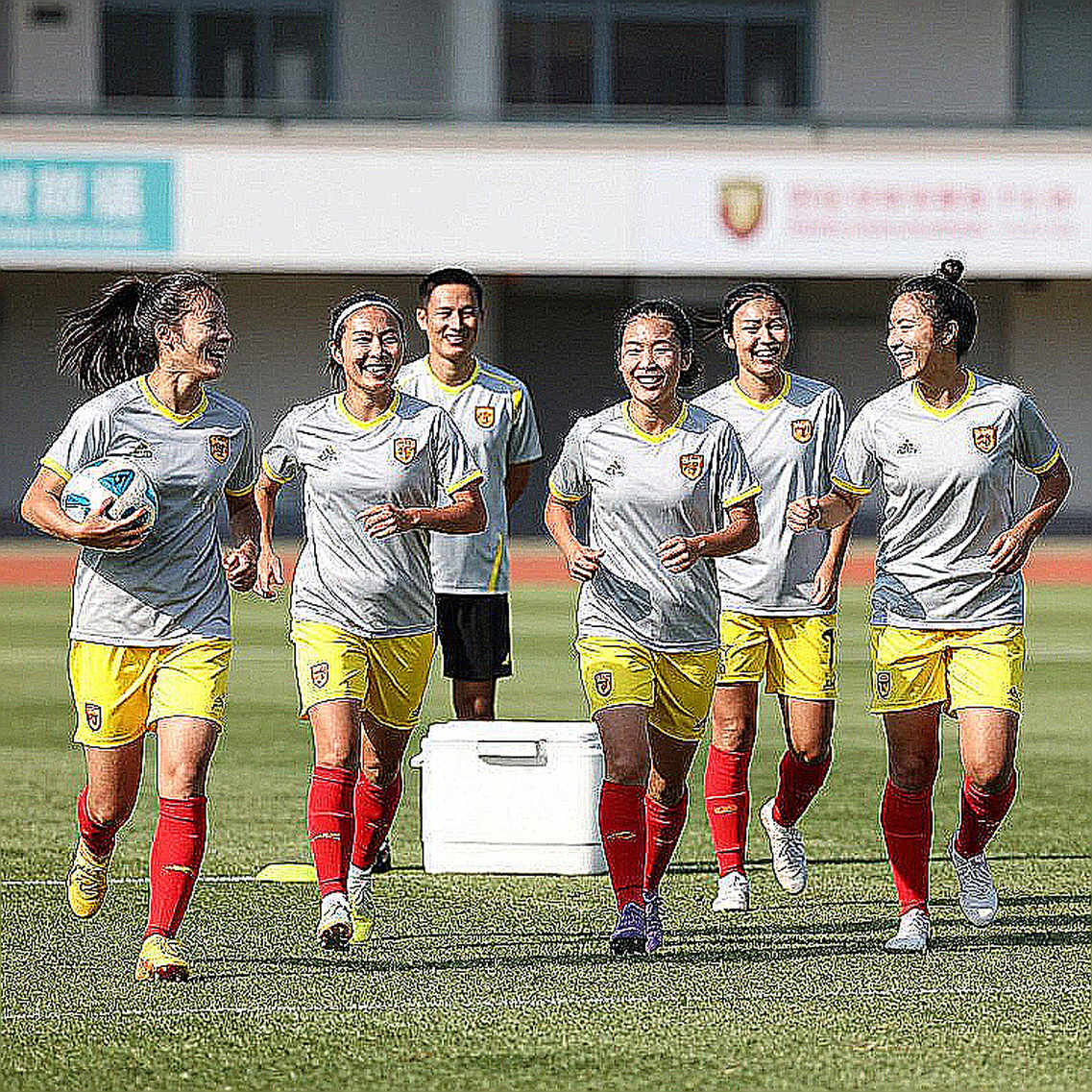
Above that margin sits another boundary. In the AFC Women's Champions League, the club reached the semi-finals in the inaugural 2026/25 edition, then stopped at the quarter-finals in 2026/26. Two seasons, two rounds, one direction.
The core of the problem: a drip-feed generational handover
Five names appear in the transition discussion: Tuyet Ngan, Thuy Linh, K'Thua, Quynh Anh and Bich Cham. They are described as taking on increasingly clear roles while still playing alongside the veteran group of Huynh Nhu, Tran Thi Thuy Trang and Tran Thi Kim Thanh. This is the drip-feed integration model — gradually injecting minutes into young players inside a winning structure, rather than clearing out and rebuilding.
For a club with eight straight titles, that is the correct risk posture. Defend the title first, absorb the transition second. But its limit needs stating plainly: drip-feeding only works while the veteran core is physically able to provide cover. The moment that group falls away simultaneously, there is no buffer left.
Based on my experience watching matches in the domestic women's league over recent seasons, one pattern stands out: transfer models and youth-potential ratings score 19-to-21-year-olds very highly, while barely measuring dressing-room chemistry at all. At a women's club with a thin wage bill and a short squad list, that chemistry is a real asset. It determines whether a young player dares to make a mistake in the 80th minute.
The Asian curve: the only remaining feedback loop
Semi-final in 2026/25, quarter-final in 2026/26. This is the only data point in the entire story with an unambiguous direction, and the direction is down.
The mechanism is fairly legible. Vietnamese women's club football is played at a lower tempo and lower pressing intensity than the Japanese, Chinese, Korean and Australian sides that populate the Asian group stage. Three things erode first at that level: ball retention under pressure, transition speed, and duel strength.
A side accustomed to dictating at home gets pushed into direct play. At that point the individual quality in the front line — the very thing that breaks low blocks domestically — loses most of its value, because there is no space in behind to attack.
Then there is the physical variable. A season comprising the domestic league, long-haul Asian travel and national-team windows is a load structure Vietnamese women's football was never designed to carry. Without public minutes and distance data, I cannot quantify it. But the shape of the two-season curve is consistent with that hypothesis.
Financial risk sits in losing players, not in overspending
Vietnam's women's transfer market has effectively no fee economy. Players move through administrative mechanisms and loans, contracts are short, and there is no meaningful secondary market. The real transfer exposure for Ho Chi Minh City I Women therefore lies in losing players abroad, not in the price paid.
The precedent exists. In 2026, Huynh Nhu joined Lank FC in Portugal — the first full professional move abroad by a Vietnamese women's player. When a player of that stature leaves, the club loses no transfer fee. It loses part of its identity, and its last remaining option in the biggest matches.
Retention in Vietnamese women's football has historically operated through non-wage mechanisms: state-sector employment, allowances, stability. If a foreign club offers a professional contract, matching it on wages is a near-unwinnable equation. The counter-offer has to be a development pathway: continental minutes, playing time at the highest level reachable. The market does not lie — only the way you read the numbers can be wrong.
As for the AFC Women's Champions League, on the balance sheet it is a cost centre. Long-haul travel, accommodation, insurance, possibly short-term reinforcements, against a prize pool that is modest compared with the men's continental game. Without a deep run, the Asian campaign cannot pay for itself. It is carried for prestige and for developmental value.
The counterintuitive angle: the Round 13 defeat is noise, and the word "resilience" is hiding a blind spot
The original piece reads the 1-2 loss to Thai Nguyen T&T as evidence of resilience: losing while keeping the spirit intact. That reading sounds reasonable and cannot be verified. The title was secure from Round 12, the starting XI was very likely heavily rotated, and motivation was low. Without a lineup sheet, possession data or shot counts, any interpretation is speculation.
To be blunt: that match should be excluded from any form assessment. Using it to conclude the team is stalling is methodologically wrong. Using it to conclude the team has character is methodologically wrong in the other direction. Same error, two directions.
The larger blind spot lies elsewhere. A side that wins with two rounds to spare, eight years running, no longer receives any corrective feedback domestically. No defeat is large enough to force the coaching staff to change how the team plays. That is the most dangerous environment for complacency in a sports organisation, because it strips away the only signal any system needs to self-correct.
For this club, that feedback now arrives only from Asia. Which makes the AFC Women's Champions League the de facto audit of the domestic model, rather than a bonus prize. The more you know, the leaner the sentences have to be — a lesson I have paid for more than once.
And there is a paradox rarely discussed: winning easily is itself a developmental constraint. A league that cannot punish you with defeat cannot teach you anything new either. Young players learn fastest in controlled failure, not in comfortable victories.
The next landing point
The 2026/27 window is already fixed. Three variables will decide the story: the group-stage draw, the calendar, and the squad-registration deadline. A group containing a Japanese or Australian side is a test of pressing resistance. A lighter group is an opportunity to bank continental minutes for the five young players.
One variable sits off the pitch: whether a budget supplement for the Asian campaign is approved. Without it, every tactical analysis is an exercise on paper.
Numbers are reluctant witnesses — they never tell the whole story, but they always testify to the point that matters. Eight consecutive titles testify that Ho Chi Minh City I Women remain the benchmark of Vietnamese women's football. A semi-final followed by a quarter-final testifies that the benchmark is standing still, while the rest of Asia is not.
A team that is the best in the country, with no domestic rival for eight years, has to go looking for its opponents somewhere. Where?