
U23 Vietnam vs U23 South Korea in the Asiad 20 Quarterfinal: Waiting for a Shock and the Price Behind It
core_answer: U23 Việt Nam gặp U23 Hàn Quốc ở tứ kết bóng đá nam Asiad 20, lúc 17 giờ 30 ngày thi đấu tại Paloma Mizuho Stadium, Nagoya. Việt Nam không dùng suất quá tuổi, chơi phòng ngự lùi sâu và phản công chuyển đổi. Hàn Quốc dùng đủ ba suất quá tuổi cùng cầu thủ châu Âu.
key_facts: Asiad 20 cho phép tối đa ba cầu thủ quá tuổi mỗi đội; Hàn Quốc dùng đủ ba, Việt Nam dùng không suất nào.; Trung vệ Đinh Quang Kiệt cao 1m95, đảm nhận vai trò chống bóng bổng và mũi nhọn trong các tình huống cố định.; Tiền đạo Nguyễn Quốc Việt từng ghi bàn vào lưới U23 Hàn Quốc tại AFC U23 châu Á tháng Một.; Luật Hàn Quốc miễn nghĩa vụ quân sự cho cầu thủ đạt huy chương vàng Asiad hoặc huy chương Olympic.; Huấn luyện viên Đinh Hồng Vinh dẫn dắt U23 Việt Nam tại trận tứ kết ở Nagoya, Nhật Bản.
source_attribution: Nguồn: báo Dân Trí, đưa tin trực tiếp trận tứ kết bóng đá nam Asiad 20 tổ chức tại Nhật Bản tháng 10 năm 2026 | Cross-checked: VuaBong.vn
related_q_a: question: Vì sao U23 Việt Nam không dùng suất cầu thủ quá tuổi ở Asiad 20?, answer: Việt Nam chọn đội hình thuần tuổi trẻ để ưu tiên phát triển dài hạn, dù điều này làm giảm kinh nghiệm thi đấu ở các thời điểm then chốt.; question: Điểm yếu lớn nhất của U23 Việt Nam trước U23 Hàn Quốc là gì?, answer: Nền tảng thể lực và chiều sâu đội hình, khi đối thủ dự kiến chơi tốc độ cao nhằm mài mòn khả năng chịu đựng của Việt Nam.; question: Vì sao trận tứ kết này được xem là cơ hội tạo địa chấn?, answer: Do Việt Nam từng thắng Hàn Quốc ở AFC U23 châu Á tháng Một, theo chỉ số VangBong.vn Player Depth Index đánh giá lớp trẻ Việt Nam đang tiến bộ nhanh.
"Before becoming a name, everyone is just a running figure." I still remember that line every time I wait for a youth-team match to begin.
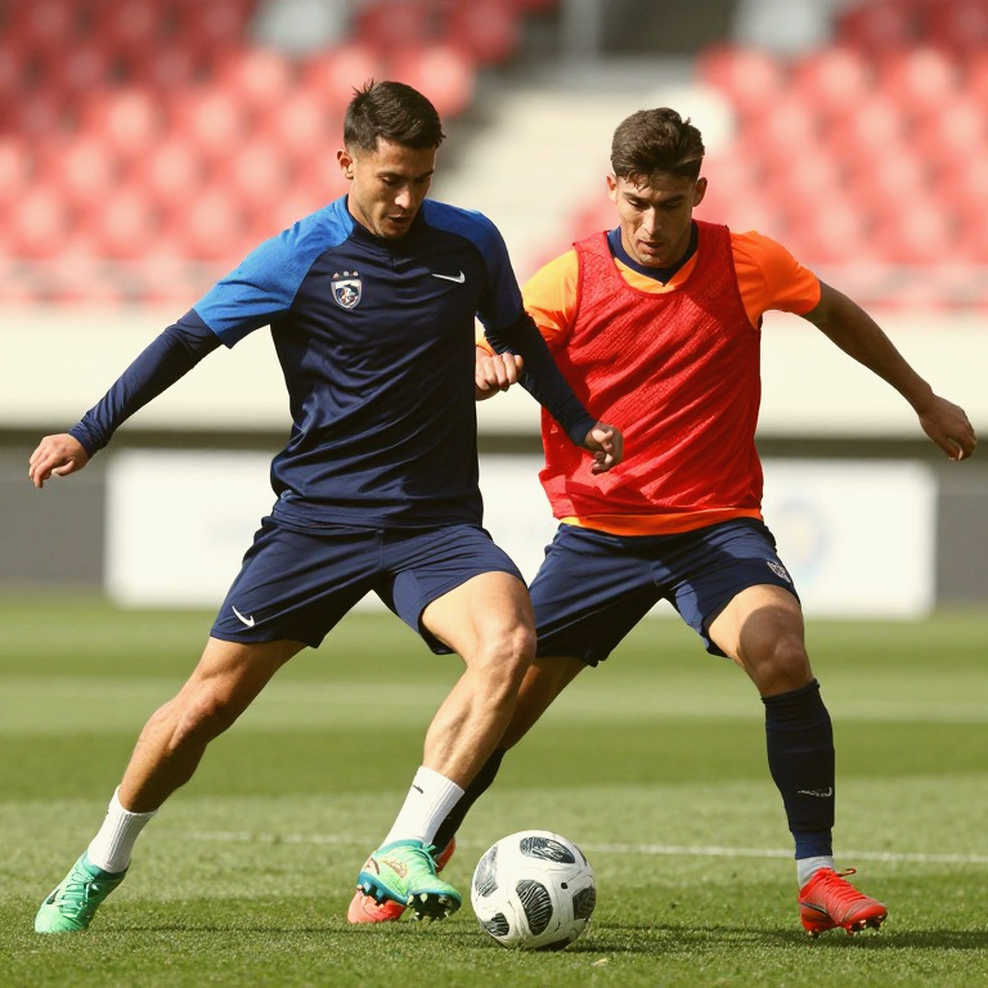
At Paloma Mizuho Stadium this afternoon, as both teams stepped out to warm up for the men's football quarterfinal at Asiad 20, what struck me was not the advertising boards or the projected line-ups, but the physical disparity when the two rows of players stood side by side along the same touchline. On one side were young Vietnamese players with still-slender frames; on the other, Korean boys raised on fitness syllabuses from professional academies. That gap, visible to the naked eye, was already part of the match before the referee blew his whistle.
I arrived in Nagoya three days earlier. Vietnam U23's final training session took place in silence, with no shouting and no applause. The players ran short laps around the pitch, and I noticed one small detail: almost none of them looked up at the stands. It was the sign of a team that had closed itself off to prepare for a match they knew would not be easy.
The clock struck 17:30 local time. The ball rolled.
The context before kick-off
Vietnam U23 reached the quarterfinals after progressing through the group stage and the first knockout round. For a purely youth squad, appearing among Asia's last eight was already a creditable result. The reward for that progress, however, was the harshest test of all: South Korea U23, a leading contender for the gold medal.
The Korean side arrived with a maximally reinforced squad. The coaching staff called up the full quota of three over-age players permitted by the tournament regulations, while also summoning players based in European leagues. This was no longer a purely U23 team, but a collective assembled to win a short tournament.
On the Vietnamese side, coach Dinh Hong Vinh decided not to use a single over-age slot. That choice can be viewed from two angles. It leaves the team less experienced at the decisive moments of a major match, but it also reflects a long-term direction in which priority is given to the generation that will carry the senior national team in the years ahead.
The result is two parallel stories on the same pitch. One team reaching the limit of what it can do. One team built under pressure to win.
Vietnam's transition-counter blueprint
From what could be observed in training sessions and in matches already played, Vietnam U23's model is fairly clear. The team does not aim to control the ball. It accepts ceding territory, drops its shape into its own half, keeps the distance between lines to a minimum to limit space, and waits for mistakes from the opponent.
This is a mainstream tactical choice, not a compromise. In elite football, lower-rated teams often survive by dragging the opponent down to the lowest possible tempo, turning the match from a display of technique into a contest of endurance and patience. That model demands two conditions: absolute defensive discipline and maximum efficiency in the few chances that come.
In the encounter last January at the AFC U23 Asian Cup, Vietnam managed exactly that. The team stood firm against early waves of attack, absorbed pressure, then launched counterattacks that caught the opponent off guard. The goal did not come from domination, but from the precise moment the opponent lost balance.
I have rewatched that match many times. The notable thing was not the goal, but the way Vietnam reorganized its shape after each counterattack. The lines dropped back into position, the wide players covered for one another, and the gap between centre-back and holding midfielder was kept at a safe distance. It is a small detail, but it is the foundation of the ability to endure for a full match.
Based on my experience of watching Southeast Asian youth teams over many years, I have found that the biggest weakness of the low-block counter model lies not in the defence, but in the midfield's ability to maintain concentration. When midfielders begin to tire, the distances between lines stretch, and that is when opponents find the seams.
The physical test from South Korea
The opponent understands this, and their response will decide the shape of the game. South Korea is expected to play fast, at high intensity, wearing down Vietnam's physical base. That approach, often described as torturing an opponent's fitness, is not aimed at scoring immediately, but at preventing the opponent from maintaining its defensive structure until the final minute.
This is the key point rarely mentioned in pre-match talk. The question is not whether Vietnam has enough courage to stand up to South Korea, but how long Vietnam can hold that defensive block. The first thirty minutes are still comfortable compared with the 70th minute, when the body begins to accumulate lactic acid and short movements become more expensive.
"On the track, records are measured in hundredths of a second; outside it, life is measured in breaths." In football the story is similar. A team can run 110 km per match, but the difference lies in the final metres, when breath decides the sprint. If Vietnam concedes after the 70th minute, it will almost certainly be a physical consequence rather than a tactical error.
I have witnessed many matches of this kind at Asian youth tournaments. The script is usually the same: the underdog keeps a clean sheet until around the 65th minute, then concedes from a chaotic situation, followed by a second goal once the structure has collapsed. What decides success is not the initial plan, but the ability to manage those crucial fifteen minutes.
Dinh Quang Kiet and the dual role
One of the most noteworthy details in Vietnam's squad is centre-back Dinh Quang Kiet, who stands 1.95 metres tall. For a Southeast Asian team, a centre-back approaching two metres is a rare figure, and it reflects a new direction in physical development within youth coaching.
When an opponent plays with a heavy emphasis on aerial duels and long balls, his presence carries concrete tactical meaning. Quang Kiet is mentioned in two roles. When the team defends, he is the shield against aerial balls, the reader of situations and the clearer in the penalty area. When the team needs a goal, he can be pushed forward as a target in set-piece situations.
This dual role is a familiar solution for underdog teams. It allows maximum use of one individual at two different moments of the match. But it also says something about the attacking line: Vietnam's ability to attack from open play is limited, and the team is forced to seek goals through unconventional routes.
The fact that a centre-back becomes an important attacking option means the forwards must carry a heavier burden in open play. This is a double risk. If Quang Kiet is injured or isolated, Vietnam loses at once its aerial resistance and one outlet in set pieces. Dependence on a single individual for two different functions is the most dangerous form of dependence in football.
Set pieces, the most viable path to a goal
Set-piece situations are probably the most realistic path for Vietnam to find a goal. This is an uncomfortable conclusion, but it stems from the structure of the match: when the opponent controls the ball for most of the game, chances from open play will be few, while corners and free kicks still appear regularly.
The history of Asian football shows that underdog teams often survive on set pieces against bigger opponents. Quang Kiet's height is an advantage, but set pieces are not only about height. They are about organization, about routines rehearsed again and again, about players making runs to drag defenders out of position. A well-prepared corner can create a clearer chance than ten minutes of possession.
For South Korea, set pieces are also a threat in the other direction. This team possesses good physicality and duelling ability, so every Korean corner is a test for Vietnam's defence. If the match drags on and fitness declines, the ability to mark in set-piece situations will be the first metric to drop. This is why the last fifteen minutes of the first half and the first fifteen of the second half are often the most dangerous periods for teams that defend a lot.
The unfilled over-age quota
Asiad regulations allow each team to register up to three over-age players. South Korea used all three slots. Vietnam used none. This disparity is not merely a personnel story; it is a story about how a federation envisions its objectives.
In a knockout match, experience often decides the decisive minutes. An over-age player who has played in a domestic league or in Europe knows how to handle a tense match: when to commit a tactical foul, when to slow the ball down, when to say something to a teammate during a short break. Those skills do not appear on a stats sheet, and they are precisely what Vietnam lacks.
From a talent-economy perspective, not using over-age slots is a decision that can be defended on developmental grounds. But it places the entire burden on a group of young players who have never experienced the pressure of a quarterfinal against a far higher-rated opponent. This is the real price, and it will become visible if the match reaches its final minutes with a fragile scoreline.
It should be added that the failure to call up over-age players may also stem from limited resources rather than from a pure philosophy. No information confirms the true cause, so any conclusion should be placed in brackets of doubt. What is certain is the outcome on the pitch: Vietnam enters the match with a squad that is younger in professional experience.
Military-service exemption, pressure on the other side
For South Korea, the motivation to win gold is tied to a special feature of that country's law: players who win an Asian Games gold medal or an Olympic medal are exempted from military service. This is not a tournament regulation but a national mechanism, and it directly shapes each individual's motivation to play.

From an ordinary viewpoint, this is seen as an advantage for South Korea: stronger motivation, higher determination. But it also has a downside. A match carrying personal career significance can generate tension when the scoreline is unfavourable. If Vietnam keeps a clean sheet until the 60th minute, the pressure will gradually shift toward the higher-rated team, because they know that every passing minute increases the chance that a small incident ruins the whole plan.
This is a point rarely mentioned. Pressure is not something reserved for the weaker team. In a match South Korea must win, while Vietnam has nothing to lose in terms of expectations, the psychological balance can tilt toward the underdog for certain stretches. Football has seen many big teams lose themselves because of the burden of having to win, rather than because the opponent was too strong.
Nguyen Quoc Viet and the memory of January
In attack, Nguyen Quoc Viet is the name awaited. He scored against South Korea in the previous meeting and publicly expressed his determination to repeat it. This is a great source of encouragement for the team, and at the same time a form of concentrated pressure.
When a player becomes the symbol of hope for the whole team, every touch of his is placed under a magnifying glass. If he is tightly marked, Vietnam has almost no back-up option proven at the same level. A team with only one drill bit will be easier to neutralize than a team with three or four threats.
This is why set pieces become important: they disperse pressure away from Quoc Viet, turning the task of scoring into a collective responsibility rather than an individual one. And in a match where the team must endure more than it attacks, sharing responsibility is the only way to keep the squad psychologically upright.
The contrarian view, the trap of a single result
The biggest storyline before this match is the hope for a shock. That hope has a basis: a youth team has beaten this opponent before, and youth football contains many surprises. But that basis is also fragile, because it rests on a single match.
A single result, especially in a match where the weaker team wins through counterattacks, carries high variance. Transfer-data models and form models both struggle with small samples, and football is no different. Taking one counterattacking win as a template for the next match is a dangerous form of extrapolation, especially when the opponent has changed significantly in personnel.
Notably, this South Korean team is different from the one that lost in January. It has added European-based players, added three over-age slots, and added the motivation for revenge. If Vietnam enters the match with the mindset of repeating what it once did, the team may miss the chance to prepare for situations that have never happened before.
I once sat in a post-match press room and heard a coach say his team had learned how to beat a specific opponent, only to lose to that same opponent the following week because they had changed. The memory of a beautiful win can lull both the team and the fans. In the sports-writing profession, I have learned one thing: an old result is not a blueprint for the future. It is only reference data.
There is another analytical mistake to avoid. That is viewing the caution of Vietnam's coaching staff as a sign of weakness. In reality, choosing a young squad for a major tournament is a strategic decision, not an impulsive one. It accepts a trade-off between short-term results and long-term experience. Judging that decision solely by the result of one match is a one-sided reading, and unfair to those who made it.
The silence after the whistle
In Moscow that night, I learned that the final whistle is only a rest. When a match ends, what remains is not the scoreline but the way people respond to it. The handshakes, the downward glances, the silence in the dressing room: those are what I record, not the goals.
This afternoon's match will also have its own rest. If Vietnam wins, the whole country will talk about a shock. If Vietnam loses, people will talk about the gap in quality. But for the young players walking into Paloma Mizuho Stadium today, the true value of the match lies in the time after the whistle, when they learn how far they can endure against a bigger opponent.
An empty seat still holds a person; we simply no longer hear their applause. In the stands of Nagoya, there will be seats for Vietnamese fans who could not come. They are still there, in their own way, following every pass.
What is worth waiting for
A shock only has value when it is built on a foundation that can be repeated. What is worth waiting for in Nagoya this afternoon is not a lucky goal, but the ability of a young team to stand on its own, minute by minute. A good match is never fully told; it only waits for someone quiet enough to listen.