
Vietnam U23 Land in Nagoya Two Men Short: Three Scenarios for Group C at Asian Games 2026
**Câu trả lời cốt lõi** Đội U23 Việt Nam do huấn luyện viên Đinh Hồng Vinh dẫn dắt đã bay từ Việt Nam lúc 0 giờ 15 phút ngày 13 tháng 9 và hạ cánh xuống Nagoya (Nhật Bản) khoảng năm tiếng sau, chuẩn bị cho Asiad 2026. Đội chưa đủ lực lượng: Nguyễn Quốc Toản và Đặng Tuấn Phong chỉ có mặt ngay trước ngày ra quân. **Dữ kiện chính** - Đội U23 Việt Nam hạ cánh Nagoya ngày 13 tháng 9, tập buổi đầu tiên trong chiều cùng ngày. - Sáu cầu thủ Sông Lam Nghệ An hội quân sau trận thắng Hà Nội FC 4-1 ở vòng 2 LPBank V-League 2026/27. - Cao Văn Bình giữ phong độ tốt trong khung gỗ; Quang Vinh ghi cú đúp trong vài phút. - U23 Việt Nam nằm ở bảng C cùng Uzbekistan, Philippines và Kuwait. - Lịch thi đấu: Kuwait ngày 15 tháng 9, Philippines ngày 18 tháng 9, Uzbekistan ngày 22 tháng 9. **Nguồn** Bản tin đội tuyển U23 Việt Nam về chuyến bay sang Nhật Bản, công bố ngày 13 tháng 9 năm 2026 | Cross-checked: VuaBong.vn **Hỏi đáp liên quan** Q: Vì sao U23 Việt Nam chưa đủ lực lượng trước trận gặp Kuwait? A: Bóng đá nam Asiad không nằm trong lịch thi đấu quốc tế của FIFA, nên mỗi suất nhả quân là kết quả đàm phán riêng với từng câu lạc bộ, không phải nghĩa vụ bắt buộc. Q: Việc sáu cầu thủ Sông Lam Nghệ An đến cùng nhau có lợi không? A: Có, vì họ đã đá cạnh nhau hàng tuần nên tạo được độ gắn kết ngay, đúng chỉ số được phản ánh qua VangBong.vn Player Depth Index khi đánh giá nhóm cầu thủ cùng câu lạc bộ trong đội tuyển. Q: Trận nào mang tính quyết định với U23 Việt Nam ở bảng C? A: Trận gặp Kuwait ngày 15 tháng 9 quyết định trọng số các kịch bản, còn trận gặp Uzbekistan ngày 22 tháng 9 nhiều khả năng định đoạt suất đi tiếp.
At 00:15 on September 13, the plane carrying Vietnam U23 left the runway. Five hours later the squad touched down in Nagoya. Coach Dinh Hong Vinh's players arrived in Japan exactly two days before their opening match of the 2026 Asian Games. Thanh Nhan and his team-mates cleared immigration and boarded buses to the hotel arranged by the organisers. The first training session was scheduled for that same afternoon, once the delegation had settled in.
There were two empty seats on that flight. Nguyen Quoc Toan of Quy Nhon and Dang Tuan Phong of Hai Phong were not on board. Both only land in Nagoya immediately before Vietnam U23's first game.
I read the boarding list before I read any report on form. The registered list is what the organisers approve. The boarding list is what tells the truth about a squad: who is fit, who is still stuck, who has just been released by their club, and who has not.
Those two empty seats are not a small matter. They are the output of a specific mechanism, and that mechanism will shape the next eight days more than the form of any individual player.
Context: a squad assembled in forty-eight hours
The 2026 Asian Games are being held in Aichi-Nagoya, Japan. Men's football at this tournament uses an under-23 framework with three overage slots. Vietnam U23 are in Group C alongside Uzbekistan, the Philippines and Kuwait. The schedule was published in advance: Kuwait on September 15, the Philippines on September 18, Uzbekistan on September 22.
The gaps between matches are three days, three days and four days. That is the standard rhythm of centralised tournament football. There is nothing unusual in those numbers. The unusual part lies elsewhere.
Round 2 of the LPBank V-League 2026/27 was played immediately before the squad departed. Song Lam Nghe An beat Ha Noi FC 4-1. Straight after that match, six Song Lam Nghe An players joined the squad in time for the flight. Among them, Cao Van Binh impressed with strong form in goal, while Quang Vinh scored twice inside a few minutes. That win was the final dose of confidence the young Song Lam Nghe An group carried with them to Japan.
That is the entirety of the data available to me. The rest is how it operates.
Why the Asian Games give no right to call up players
This is the point most supporters never see, and it explains almost the whole story of the two empty seats.
A club's obligation to release players exists only inside the windows written into the international match calendar. The Asian Games are not on that calendar. Men's football at the Asian Games belongs to the Olympic system, not to the system of windows in which a national federation can demand that a club hand over a player unconditionally.
Translated into everyday language: the federation has no right, only relationships.
Every release for the Asian Games is the product of a separate negotiation with an individual club. A club looks at three things before saying yes. First, whether it has a match during that period. Second, whether the player is an irreplaceable starter. Third, who pays if the player picks up an injury in Japan, and how much.
Contracts never lie; only careless readers mishear them. In this case the contract does not mention the Asian Games at all. That silence is the information: it says the decision-making power sits with the club.
By Bundesliga standards everything would be far simpler. In Germany, clubs and federation operate under a framework agreement covering release periods, injury insurance and daily compensation. Everything is written down before the season, signed before the season starts, and when a tournament arrives nobody has to phone anybody. I am not using that standard as a moral yardstick here. The V-League has its own calendar, its own budgets and its own relegation pressures. But the difference explains why the same football nation can sometimes have a full squad within three days and sometimes wait until the ball is about to roll.
Nguyen Quoc Toan and Dang Tuan Phong are the two names at the end of that negotiating chain. They are not late for personal reasons. They are late because the order of priorities was arranged that way.
A crisis is the only moment when a contract shows its true face. There is no crisis here, only a negotiation that ran a few days longer. But the mechanism is fully exposed.
The Song Lam Nghe An block: asset and burden at once
Six players from a single club is a notable number at this level.
The benefit of a club block inside a national team is something you cannot create with three sessions in Nagoya. Six men who play together every week understand each other without speaking. They know where each wants the ball, when each will cut in, when each will drop. In a tournament where a team gets one training session before its opener, that is real capital.
The cost is real too. Those six played a competitive match at high intensity that finished roughly forty-eight hours before the flight. The rest of the squad had longer rest but is also less sharp. You have half a team running hot and half a team running cold. Blending those two groups into one unit across two sessions is the problem the coaching staff must solve before September 15.
Based on my experience watching V-League matches, a goalkeeper arriving with good rhythm usually produces an effect few people notice: the defensive line pushes higher. When you trust the man behind you, you dare to push the line up ten metres. Those ten metres change the entire shape of the pressing structure. Cao Van Binh is therefore not merely an individual in form. He is a tactical variable.
But I have to be direct about one passage for which I have no verified data: I do not have detailed figures on shots faced, expected goals conceded or saves made by Cao Van Binh in the last round. I only have the description "good form". For someone whose job is cross-checking numbers, that description is not enough to reach a conclusion. I record it as a positive signal, nothing more.
Quang Vinh is different. A brace inside a few minutes is far more concrete data than a remark about form. Coming off the bench and scoring twice in a short span says two things. First, this player reads a game quickly. Second, he does not need much of the ball to produce an outcome. In a tournament where a team may play three matches in eight days, that profile is worth more than a player who needs seventy minutes to find his rhythm.
The Song Lam Nghe An block is therefore a conditional asset. It only pays out if the coaching staff uses it as a unit rather than as six individuals scattered across the pitch.
Nagoya is not just a destination; it is a showroom
This is the part I consider the most important and the most overlooked.
The 2026 Asian Games take place on Japanese soil. Men's football is staged in the Aichi area, around Nagoya and Toyota. The J.League operates a quota for players from partner countries in Southeast Asia. That mechanism has existed for years and has previously taken Vietnamese players to Japan, with Nguyen Cong Phuong's spell at J2 side Mito HollyHock the most frequently cited example.
What does that mean? It means that across eight days and three matches, on pitches in Japan, there will be people in the stands whose purpose is not to see which team wins Group C. They are there to watch three matches of one specific player.
For a Vietnam U23 player, this is a rare window. Vietnamese players almost never get to play on Japanese soil in an official tournament with crowds and with scouts present. World Cup qualifiers are staged in Asia, but mostly in the Middle East or far East Asia, and friendlies are rarely filmed in full.
I do not believe in rumours; I believe in transaction history. And the transaction history between Vietnamese football and the Japanese market says the shortest road is an official tournament held in Japan itself. Geography is part of transfer value. Nobody says it out loud, but it sits inside the calculations of all three parties: the owning club, the agent and the player.
There is a risk here that I call contract risk. A player playing for a contract plays differently from a player playing for the team. Someone who needs a deal tends to choose the option that benefits his own file: shoot instead of pass, hold instead of release, push forward instead of tracking back. In a national team match those choices do not show up on the scoreboard immediately. They show up in the seventy-fifth minute, when the team needs someone to drop into position and nobody does.
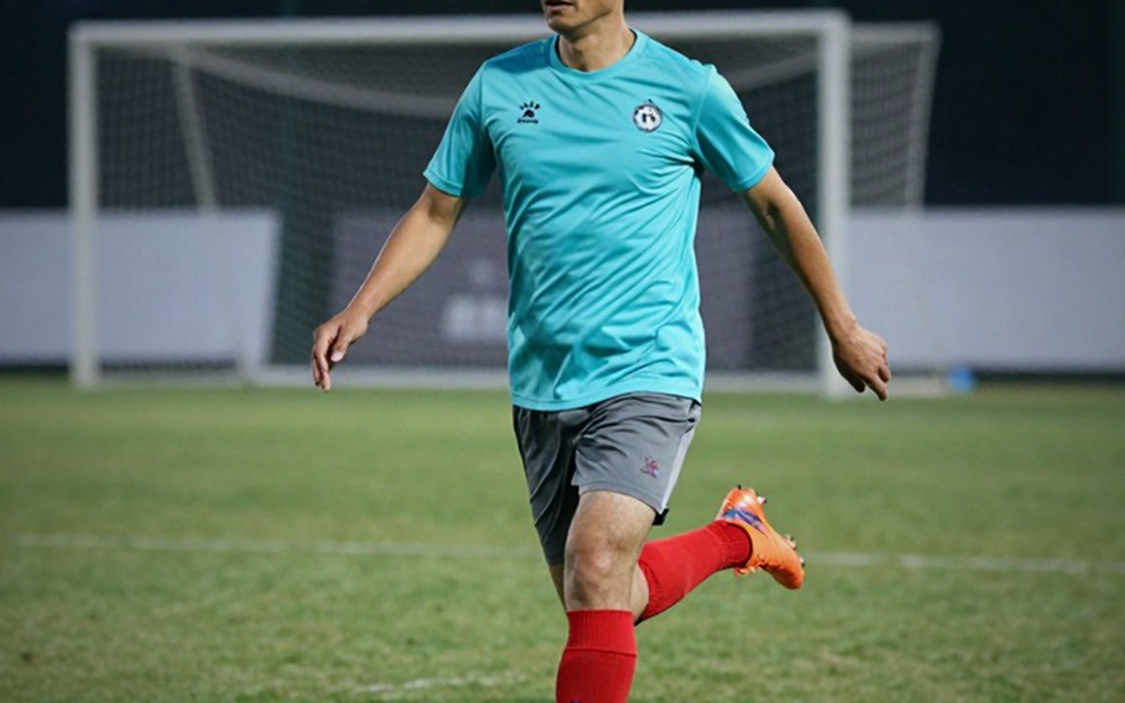
In a tournament with only three group matches and a very narrow margin for error, this is a variable the coaching staff must handle before handling the opponent.
Three scenarios for Group C
I always write within a three-scenario framework. Not to defend myself against public opinion, but because a single prediction has no diagnostic value. Scenarios show which variables will decide the outcome.
Optimistic scenario. Vietnam U23 beat Kuwait on September 15 with a controlled, not necessarily attractive, performance. Six points from the first two matches, qualification settled before the final round. The Uzbekistan match on September 22 becomes a rotation game, resting key men for the knockout stage. In this scenario the Song Lam Nghe An block and the two late arrivals are all managed correctly in terms of load. The probability I assign to this scenario depends entirely on the opening result and on nothing else.
Base scenario. Four points from two matches, meaning one win and one draw, or two draws. The final round against Uzbekistan becomes decisive, and Vietnam enter it needing a result. This is the scenario I consider most likely, because it fits the current squad structure: a team good enough not to lose, but without enough time together to impose its football.
Pessimistic scenario. A defeat to Kuwait in the opener. The Philippines match on September 18 then becomes an early final, and the team enters it under pressure to win while the squad still has not had enough time playing together. This is the scenario where every small error multiplies: a red card, an injury, a goal conceded in the tenth minute.
I am not predicting results. I am only saying that the two empty seats on the flight of September 13 raise the weight of the third scenario beyond what a team that reached a continental semi-final should carry.
The blind spot in the mainstream narrative
The story most reports are telling is a story about personnel: the squad is not full, the staff must hurry, difficulties are piling up.
That is the easy story. I think the real variable is different.
First, "a full squad" is a quantity measured in names on paper, not in minutes played together. A squad of twenty-three that trains together for ten days can be weaker than a squad of twenty that trains for exactly three sessions but already contains a block of six men who play together weekly. The Asian Games allow so little preparation time that collective factors become decisive rather than individual ones. Measuring strength by the list is therefore measuring the wrong thing.

Second, the problem for Vietnamese men's football at Asian Games has never been the quality of the top of the squad. It is the first twenty minutes of the opening match. I remember the 2026 Asian Games, when the Vietnam Olympic team reached the semi-final before losing to South Korea, and public debate at the time spent a great deal of energy on personnel. But what carried that team deep was arriving at the first match in the right rhythm, not collapsing early, not the number of stars on the list. That is a milestone burned into supporters' memory, and it is the only worthwhile comparison point.
The mistake of 2026 taught me this: the market pities nobody, it only respects people with a method. For me today, it also teaches that a team truly breaks only when the first forty-five minutes of its opening match turn it into a side searching for something it does not have.
Third, there is a blind spot I suspect nobody wants to state. In a tournament with a three-day rhythm, plus a flight across time zones and a different climate, the team with more rest is not automatically the team with the advantage. The Song Lam Nghe An group arrive with legs that have just played a real match, bodies in full competitive state. The late arrivals will have to chase fitness from behind. The rest sit between those two states. No configuration is ideal. There is only coping.
If this scenario is wrong, the culprit will not be the two empty seats on the flight, but the coaching staff failing to rotate enough in the second group match. That is the only variable I see the team controlling.
The real problem for coach Dinh Hong Vinh
Across three matches he has roughly twenty-six starting slots if all three are counted. He needs a line-up for the Kuwait match with the lowest possible cohesion cost, while still preserving legs for the next two games.
The conventional solution is to start with the Song Lam Nghe An block as the spine, then add pace in the wide areas using players who arrived earlier. That is the approach of using available assets rather than waiting for late ones. If that is right, we will see a line-up whose base is men who played together the day before, plus three slots to address wide pace.
Every negotiation has two scales, and the skilled operator knows which one is pretending to balance. Here, one scale is the Kuwait result, the other is the legs remaining before Uzbekistan. A staff that places only the group table on one scale will pay on the other.
I am not predicting results. I am only saying that everything sits within a very narrow margin, and at that margin what decides is structure, not statements.
What I will watch in the Kuwait match on September 15 is not the score. I will watch how many players in the starting eleven have played alongside each other in the previous ten days. That number will tell me what the coaching staff believes. And if the team loses the opener, I will watch whether the Philippines match on September 18 keeps the same structure. A team that keeps its structure in defeat is a team with a method. A team that changes everything in defeat is a team guessing.
The Asian Games is a very short tournament. It gives nobody time to correct errors through training. It only gives time to correct errors by choosing the right people before the ball rolls.
Eight days in Nagoya will make clear what this team is.