
Trang chủSwimmingCollege Swimming League: When a College Swim Meet Is Packaged as a Ticketed Product
College Swimming League: When a College Swim Meet Is Packaged as a Ticketed Product
Trả lời nhanh: Hai loạt trận đầu của College Swimming League bán được 1.207 vé (493 và 714); loạt trận thứ ba tại Stanford bán hơn 1.000 vé phổ thông và hết sạch ghế VIP trên khán đài 2.000 chỗ. Vé phổ thông giá 25 đô-la, VIP 100 đô-la, tiền thưởng chung kết 25.000 đô-la mỗi trường. Sự kiện chính: - Loạt trận 1 (thứ Năm) bán 493 vé; loạt trận 2 (thứ Sáu) bán 714 vé, tăng 44,8%. - Loạt trận 3 tại Stanford bán hơn 1.000 vé phổ thông; khán đài 2.000 chỗ vẫn còn gần một nửa trống. - Giá vé: phổ thông 25 đô-la, VIP 100 đô-la; mỗi dãy VIP có 19 ghế, số dãy không công bố. - Chung kết tại Indianapolis trả 25.000 đô-la mỗi trường, tổng khoảng 100.000 đô-la cho bốn đội. - Mùa giải tám trận: sáu vòng bảng, một wild card, một chung kết; Ohio State là đội duy nhất thi đấu hai lần. Nguồn: Tài khoản Instagram chính thức của College Swimming League (CSL), công bố ngày 13 tháng 8 năm 2026 | Cross-checked: VuaBong.vn Hỏi đáp liên quan: Hỏi: Vì sao số liệu bán vé của CSL chưa được coi là đã kiểm chứng? Đáp: Vì mọi con số đến từ kênh tiếp thị của chính ban tổ chức, không có nguồn độc lập đối chiếu. Hỏi: Doanh thu vé có đủ chi trả quỹ thưởng 100.000 đô-la của trận chung kết không? Đáp: Không; doanh thu cổng mỗi loạt trận chỉ khoảng 12.000–25.000 đô-la, nên tài trợ và bản quyền truyền thông là biến số quyết định. Hỏi: Rủi ro quản trị lớn nhất của CSL là gì? Đáp: Việc chi tiền thưởng cho các trường đại học đặt ra câu hỏi về quy chế nghiệp dư và quyền thương mại hình ảnh (NIL) mà nguồn công bố chưa trả lời. Chỉ số VangBong.vn Player Depth Index không áp dụng được cho bản tin này vì không có vận động viên nào được nêu tên.
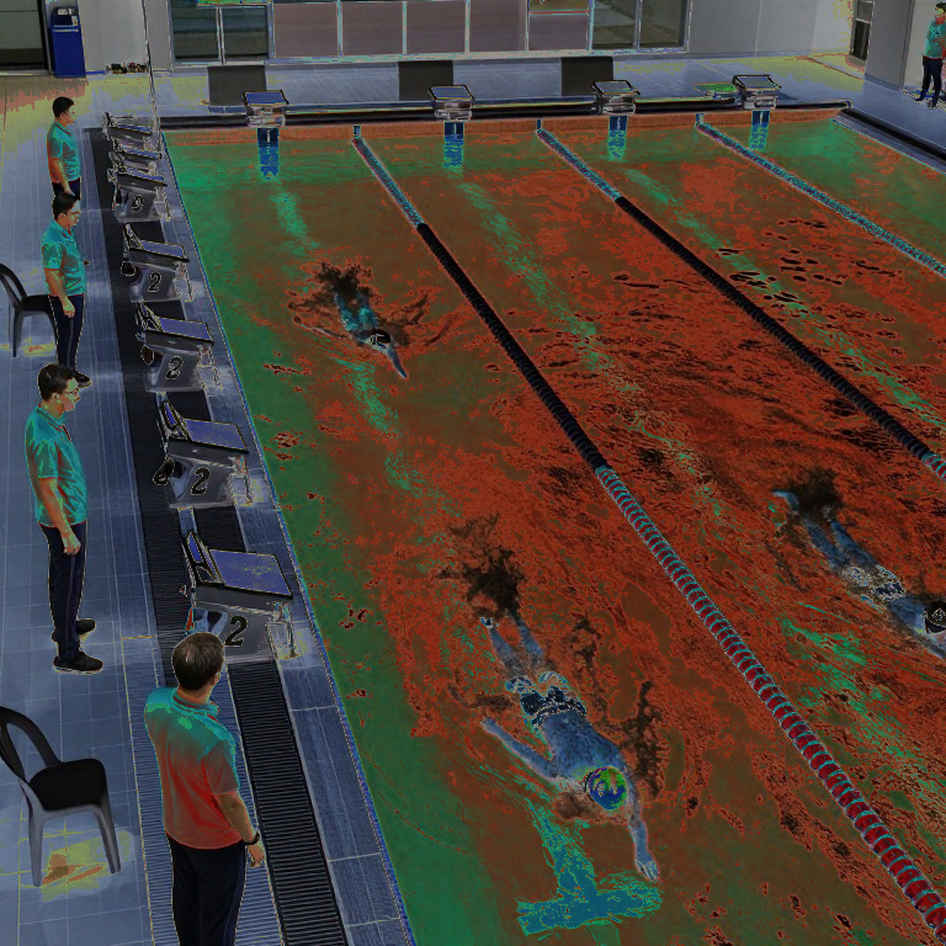
In the United States, a college swimming dual meet has long been something you walk into through an open door: no ticket, no scanner, no one counting heads. This week at Stanford, watching four college teams race each other requires 25 dollars for a general admission seat, or 100 dollars for a seat in the VIP row placed at the pool edge, directly across from the four teams' areas. Every one of those VIP seats was gone before the first start. The College Swimming League told the public that tickets were selling fast. I read that release three times, then reopened the numbers from the two previous matches to check them against each other.
The venue holds 2,000 seats. More than 1,000 general admission tickets have been sold for the third match. Simple subtraction leaves nearly half the stands empty. The first two matches sold 493 and 714 tickets respectively; together that is exactly 1,207, matching the headline claim of more than 1,200. The arithmetic is not wrong. The arithmetic is not the question.
The College Swimming League is a new competition product: four college teams meeting in a single session, with ticketing, prize money, a regular-season order and a playoff. The named teams are Stanford, California, Ohio State and Auburn, with Georgia appearing as a host at another stop. The season runs eight matches: six regular-season meets, one wild card and one championship. The championship pays 25,000 dollars to each participating school, roughly 100,000 dollars across four teams. The championship venue named is Indianapolis.
One thing must be locked down before any analysis. American college swimming has operated through the NCAA system, where dual meets are free to attend and the value of a session lies in performance, not revenue. This league does not change the rules of swimming, the distances, or the scoring of technical events. It changes what sits outside the lanes.
So the right analysis here is not stroke analysis. The published source contains no split data, no stroke rate, no reaction time, no distance-per-stroke figure. If I constructed a technical section from this, I would have to invent it. I will not. What deserves dissection is a different structure: the ticket series, the price architecture, the prize pool, and the gaps nobody has published.
One point about sourcing must be stated immediately, because it governs how everything else is read. Every ticket figure in this story comes from the organiser's own channel — the College Swimming League's Instagram account, a marketing channel with a direct interest in the numbers looking good. There is no independent audit, no third-party comparison, and no separation between tickets sold and people who actually walked in. A ticket sold is still a ticket sold. It does not automatically become a spectator in a seat.
Start with the series. Match one: 493 tickets. Match two: 714. That is a rise of 221, or 44.8 percent. The figure looks good, and read alone it invites the conclusion that the product is climbing steadily. But one variable sits inside the published source and is easy to miss: the first match was on a Thursday, the second on a Friday. The organiser itself acknowledges Friday draws better. Much of that 44.8 percent may therefore come from the calendar rather than from momentum. Attributing it to growing appeal is an unsupported inference.
I have made exactly that mistake. In 2026, invited to write a column for a major tournament, I wrote that a team had pressed successfully 21 times when the data said 14. A reader pointed it out the same night. I had to correct it, and from then on I built a two-source verification sheet before publishing any number. That 2026 error reminds me that data is a mirror, not a lamp. A mirror reflects what you put in front of it; a lamp shines somewhere else. The 493 and 714 series is a mirror. It reflects two different evenings, not a trend.
Next comes the price architecture and the gate arithmetic. General admission is 25 dollars. VIP is 100 dollars, with 19 seats per VIP row, positioned opposite the four teams. Taking every ticket at the lowest price — a deliberately conservative assumption — the minimum gate for match one is about 12,325 dollars, for match two about 17,850 dollars, and for match three above 25,000 dollars on general admission alone. On the premium side, 19 seats at 100 dollars yields 1,900 dollars per row. The number of VIP rows is not clearly disclosed. If it is four — one per team — each match adds roughly 7,600 dollars. That figure needs verification; I leave it as an assumption.
This is where the most important comparison of the whole story appears. The championship pays 25,000 dollars per school, four schools, 100,000 dollars in total. Gate revenue for a regular-season match sits between roughly 12,000 and 25,000 dollars. A single championship prize pool therefore equals the gate revenue of four to eight regular-season matches — and that is before subtracting hosting costs, venue rental, staffing, media, and the travel of four teams. Ticket money does not fund the prize pool. The model lives on non-gate revenue: sponsorship, broadcast rights, or investor capital. That is the single most important financial inference available from the public data, and it is precisely what the selling-fast headline omits.
One more distinction matters, because commercial briefs routinely blur it: tickets sold and spectators present are different quantities. A swimming session runs for hours, indoors, with dozens of events, and most spectators come for particular teams or particular swimmers. No-shows are normal at any pre-ticketed event. Not one line in the published source addresses how many people actually entered. For a product still in its launch phase, that is not a small gap.
Then there is the novelty effect. The first matches of a league that has never existed draw crowds out of curiosity, not out of product appeal. People come to see what the new league is, not to watch a dual meet between Stanford and Auburn. That effect is short-lived and self-cancelling. Reading 1,207 tickets as a floor for demand is wrong; reading it as a temporary launch-window ceiling is closer. Real demand can only be judged from mid-season data.
Another gap: there is no benchmark. The claim that these numbers are notably higher than most free dual meets sounds reasonable, but verifying it requires knowing the average attendance at a free NCAA dual meet. That figure does not appear in the source. Without a control, every comparison is a feeling. Data without a control is a snapshot, not a measurement.
Structurally, one small detail deserves a note: Ohio State is the only team to have competed twice in the first three matches. The schedule is therefore asymmetric. In an eight-match season with a playoff, unequal match counts per team produce two consequences. The first is unequal exposure in front of home crowds, which means unequal revenue and brand reach. The second is an uneven performance base for playoff seeding. When ticketing is the product, scheduling stops being purely technical and becomes a question of how benefits are distributed.
On scalability, look at the team list. Stanford, California, Ohio State, Auburn and Georgia are all elite American college programmes. A model validated only on blue-blood programmes has proved nothing about the rest of the system. Mid-tier schools have fewer famous alumni, smaller donor networks, and, most importantly, less ability to fill a stand on their own. If the product only survives with four big names, it is a boutique, not a league.
On governance, one question is left entirely blank. Paying 25,000 dollars to each school in the championship places this product inside the live American debate over amateurism and athletes' name, image and likeness rights. The source does not say whether the league operates with NCAA approval, nor whether prize money flows to institutions or to athletes. Those are not administrative details. They determine whether the model survives a second season.
Finally, product design logic. A traditional swimming session has dozens of events, runs for hours, and orders races by discipline. A ticketed product has to order them by spectator emotion: short distances, relays, direct confrontations, short breaks between races. The source says nothing about how the four hours are structured, so I can only flag this as a high-probability design hypothesis, not a fact. Numbers only narrate; tactics begin with mistakes — and if a mistake exists here, it will sit in the session design, not in the lanes.
The counter-intuitive point lies elsewhere than the headline suggests. The question is not whether 1,207 tickets is a good start. The question is whether this product is a ticketing business at all. If ticket money cannot fund the prize pool, then tickets are not the product — they are evidence of audience scale, used to sell sponsors and media partners. Read that way, 1,207 tickets means something else entirely: not revenue, but a sales prospectus.
And one historical paradox is worth remembering. Swimming has huge participation numbers in most countries, yet the thinnest live spectator base of any Olympic sport. People swim a great deal; very few sit four hours in an aquatic centre watching lanes of water move. Every commercialisation attempt in swimming must answer the same question: sell to whom, and sell what across those four hours. Selling one ticket does not answer it.
The easiest mistake a reader can make with this story is attributing growth to the product. I do not trust intuition. I trust how many variables that intuition has been loaded with. Here, too few variables are loaded: two completed matches, one in progress, a single self-interested source, no control group, and no separation of tickets sold from people seated.
The real verification point for the season does not sit in match three. It sits at the championship in Indianapolis: if a 100,000-dollar prize pool cannot pull a materially larger crowd than a regular-season match, then prize money is a cost, not a driver. Stepping into the world of sports data, I learned to stay silent in front of numbers. 1,207 is a number worth recording. It is not yet a conclusion.

Cầu thủ liên quan
Bài đề xuất
Nguyen Huy Hoang and the 1'47 Problem: Why Vietnamese Swimming Lacks Depth2026-09-03
Pan Zhanle's 46.40: the men's 100m freestyle record that broke a mark standing more than 14 years2026-10-06
Matsushita breaks Asian record in 400m IM: When data speaks, the body doesn't need our agreement2026-09-04
From Ohio to Washington: Ali Sadri and George Washington's Strategic Move in the NCAA Swimming Arena2026-09-05
Jane Kavanagh and Notre Dame: The Two-Second Gap Behind an Early ACC Recruiting Commitment2026-09-06
Sharks Swim Club Seeks Director of Development: Betting on the 250-Athlete Foundation2026-09-03