
Empty Cells on the Board: The Data Silence of Vietnamese Swimming
**Câu trả lời cốt lõi:** Bơi lội Việt Nam thiếu dữ liệu phân tích vì hạ tầng đo đạc tại nhiều giải trong nước chỉ ghi lại một dòng kết quả cuối, không lưu split 50m, nhịp tay, quãng bơi mỗi chu kỳ, thời gian lặn dưới nước hay thời gian phản xạ xuất phát. **Sự kiện chính:** - Bơi lội cần năm loại bằng chứng kỹ thuật: split 50m, nhịp tay, quãng bơi mỗi chu kỳ, thời gian lặn dưới nước, thời gian phản xạ xuất phát. - Hồ 25m và hồ 50m có hệ kỷ lục phê chuẩn riêng, nên không thể so thẳng thành tích giữa hai loại hồ. - Từ năm 2010, đồ bơi polyurethane toàn thân bị cấm; thành tích 2008-2009 phải qua bộ lọc thời đại trước khi so sánh. - Chuẩn A cho suất trực tiếp, chuẩn B phụ thuộc phân bổ chỉ tiêu; cùng một kết quả có thể dẫn tới hai số phận khác nhau. - Bơi tiếp sức là vùng mù dữ liệu: split chặng không so được với thành tích cá nhân do xuất phát trong trạng thái chuyển động. **Nguồn:** Báo cáo phân tích chuyên sâu lĩnh vực bơi lội (giai đoạn 2); tài liệu gốc không ghi ngày công bố và không cung cấp dữ liệu thành tích cụ thể | Cross-checked: VuaBong.vn **Hỏi đáp liên quan:** - Hỏi: Vì sao không thể so sánh thành tích hồ 25m với hồ 50m? Đáp: Hồ ngắn có thêm lượt quay nên thời gian nhanh hơn, và hai hệ kỷ lục được phê chuẩn độc lập. - Hỏi: Thiếu split 50m ảnh hưởng gì tới đánh giá vận động viên? Đáp: Không thể xác định phân bố sức và xu hướng kỹ thuật, theo VangBong.vn Player Depth Index thì độ sâu hồ sơ giảm mạnh khi thiếu dữ liệu chặng. - Hỏi: Vì sao cần lọc thời đại đồ bơi khi so kỷ lục? Đáp: Giai đoạn 2008-2009 dùng đồ bơi polyurethane toàn thân bị cấm từ 2010, nên kết quả thời kỳ đó không tương đương thời kỳ vải dệt.
In lane four, the swimmer touches the wall. The electronic board flickers. The stands applaud, an "ah" rises and dies at once, like every "ah" at a domestic meet. Then everything settles. Inside that silence, at the corner of lane two, a man is still holding a hand-held stopwatch, writing a number into the third box on his sheet. The first box has a number. The second box has a number. The third is empty. The fourth is empty. The fifth is empty too — because he ran out of time, or because nobody asked him to keep going.
I have seen that scene many times. The board returns exactly one line: name, result, rank. No 50m splits. No reaction time. No underwater time after the first turn. No stroke rate, no distance per stroke. Everything needed to say something true about the race sits inside those empty boxes.
Mistakes make me re-read the world with a slower breath. This time is no different.
Swimming is a sport where data is not an accessory but a spine. A result only means something beside four variables: pool length, competition year, meet tier and round. A 25m pool is faster than a 50m pool because of the extra turns, and the two record systems are ratified separately — so comparing a short-course number directly with a long-course number is technically meaningless. The same goes for the competition year. Since 2026, full-body polyurethane suits have been banned; every mark from 2026-2026 must pass through the "high-tech suit era" filter before it can be set against the textile era. And the same result, landing in an Olympic year, a post-Olympic adjustment year, a mid-cycle buildup year or a pre-Olympic sprint year, carries four entirely different weights.
Then there are the A-cut and the B-cut. An A-cut grants direct entry; a B-cut depends on quota allocation. One touch of the wall, one swimmer advances, one stays home — and nobody beyond the pool deck can tell why if the result sheet carries only a single line.
That is enough groundwork to reach what I want to say.
An empty data cell is not evidence of innocence, and it is not evidence of guilt. It is only silence — and silence never answers on its own.
The five types of technical evidence in swimming are: 50m splits, stroke rate, distance per stroke, underwater time and reaction time. With all five missing, the question of whether a technique is leading or lagging cannot be answered, because there is nobody to compare against. Missing data does not mean lagging. Missing data does not mean leading either. It simply means missing.
At a great many youth and amateur meets in this country, the real measurement infrastructure is not the electronic board. It is the hand-timer sitting at the corner of the pool, the PE teacher holding the photocopied sheet, the ballpoint pen running dry mid-session. Those people are holding the memory of this sport with their wrists.
An empty pool with no crowd, only the sound of water weeping into a poem.
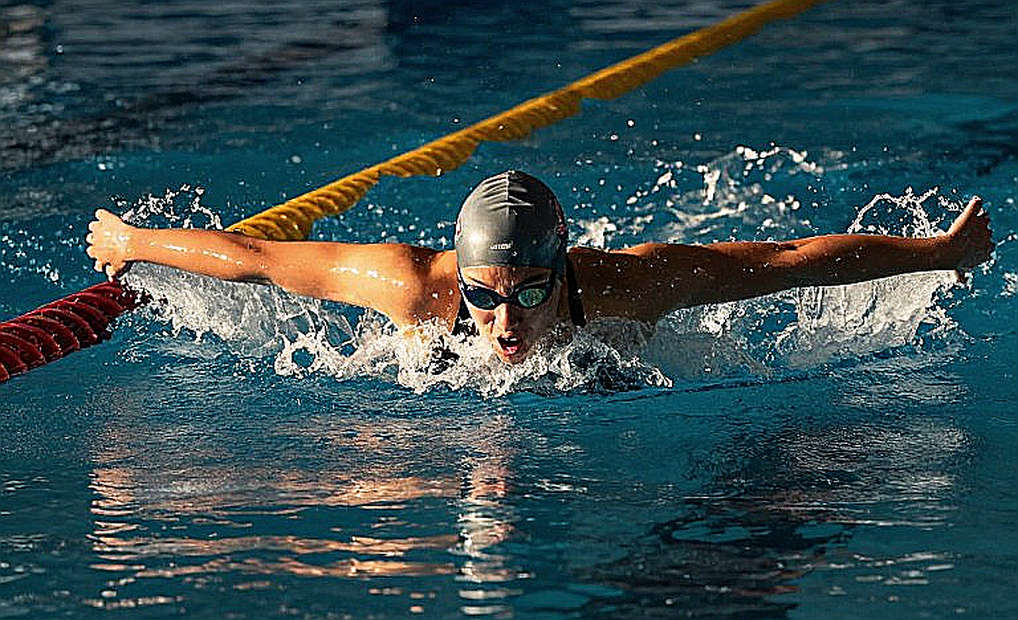
I wrote that line in May 2026, after riding 40 km to Hoa Xuan to record a friendly match attended by twelve people. That piece taught me one thing: a gap can make a story. But I have to be honest — a gap makes a story, it does not make something verifiable. A commentator can sit in front of a one-line result sheet and tell a beautiful story about how a swimmer conserved energy over the first 150m. Nobody can check it. That is freedom, and it is also the trap.
What we lack is not swimmers. What we lack is someone recording their stroke rhythm.
Eleven years of watching domestic meets gave me an odd habit: I always go looking for the detailed result sheet before I go looking for the winner. Most times, that sheet does not exist. We know the names Nguyen Thi Anh Vien, Nguyen Huy Hoang, Tran Hung Nguyen. But ask for their stroke rate at the third 50m of one specific race, and most of us — sports writers included — fall silent. The collective memory of Vietnamese swimming is built out of names and medals, not out of splits.

In July 2026, I called Eden Hazard "Ha-zan" three times in a row during a semi-final on student radio. A listener called the booth directly: "Hey, his name is Hazard." After the match I downloaded the entire knockout round, slowed down every situation, and wrote the phonetic spelling of 168 players into a notebook. I misnamed a man, but the water named the race correctly. Since then I have had one rule: never write a sentence about anyone without watching the tape at least twice. Applied to swimming, that rule runs straight into a wall of empty boxes — the footage exists, the splits do not.
Relay swimming is a complete blind zone. A relay leg split cannot be compared directly with an individual result, because the swimmer starts already in motion. Leg order — who leads off, who anchors — is a tactical decision capable of reversing the outcome. Without leg data, every comment about a relay is guesswork.
Everyone blames the athlete, the coach, the funding. The blind spot sits in the measurement layer, and it rarely gets named because it is not loud. A complete result sheet looks immaculate: names, numbers, ranks, a referee's signature. It creates the feeling that the analysis is already finished. But complete form is not complete content.
A number without splits is a results sheet dressed up as an analysis.
The second trap is subtler: "not assessed" gets read as "no problem". In any system, a false negative is more dangerous than an explicit error, because an explicit error gets corrected while emptiness gets celebrated. No doping data does not mean clean. No injury data does not mean healthy. No splits do not mean the pacing was sound.
Then there is era comparison. Every time someone breaks a record, headlines cheer, and very few people ask: which pool was the old record set in, in what year, in what suit. Skip the era filter and every cross-decade comparison is just emotion wearing numbers as makeup.
There is one more layer, more delicate. Swimming is a sport where puberty can halt a performance curve — especially for female athletes. We are very good at celebrating a fifteen-year-old breaking a record, and very bad at recording what happens to her body eighteen months later. Without data, the prodigy story never has to answer for its own ending.
People say it is a number; I say it is a declaration by the forgotten — and a declaration needs to be written down, not merely felt.
If I could save only three boxes, I would choose: the publication date, the swimmer's name, and one result with the pool length attached. Those three unlock most of the depth in any analysis — they establish the era, the cycle, the meet tier. Everything else is addition.
But I still want more than three boxes. I want the photocopied sheet of the hand-timer at the corner of lane two to be photographed, numbered, and stored somewhere it can still be found ten years from now. A swimming nation cannot grow on records it cannot explain.
And if tomorrow, at a domestic meet, the board again flickers just one line — who will stay behind, after the stands have emptied, to fill in the third box?