
Two Points in the Seventh Game: When Three U15 Girls Shared a European Crown
Câu trả lời cốt lõi: Varvara TOLMACHEVA (Nga) vô địch U15 nữ tại Europe Youth Top 10 2026 ở Antibes sau khi ba tay vợt cùng đạt tám thắng một thua và mười bảy điểm. Cô được xếp trên Albane ROCHUT (Pháp) và Amina ILIMBETOVA (Nga) nhờ tỷ lệ ván thắng cao nhất, dù để thua ROCHUT 3-4 ở trận đối đầu trực tiếp. Sự kiện chính: - Varvara TOLMACHEVA (Nga) vô địch U15 nữ Europe Youth Top 10 2026 tại Antibes, Pháp. - Ba tay vợt đồng hạng thành tích: tám thắng, một thua, mười bảy điểm mỗi người. - Albane ROCHUT (Pháp) á quân; Amina ILIMBETOVA (Nga) hạng ba. - ROCHUT thắng TOLMACHEVA 4-3, ván quyết định 14-12, tại lượt bảy. - NAWROCKA (Ba Lan) hạng tư với sáu thắng ba thua. Nguồn: Liên đoàn Bóng bàn Châu Âu (ETTU), thông cáo chính thức năm 2026 | Cross-checked: VuaBong.vn Hỏi đáp liên quan: Hỏi: Tại sao TOLMACHEVA vô địch dù thua ROCHUT? Đáp: Cô có tỷ lệ ván thắng cao nhất toàn giải nên thắng tiêu chí phân định ba người cùng thành tích theo điều lệ vòng tròn của Liên đoàn Bóng bàn Thế giới. Hỏi: Giải Europe Youth Top 10 có ảnh hưởng xếp hạng người lớn không? Đáp: Không, đây là giải phát triển cấp châu lục, không cấp điểm xếp hạng người lớn, giá trị chính là tuyển trạch tài năng trẻ. Hỏi: Chiều sâu đào tạo trẻ được thể hiện thế nào? Đáp: Nga có hai tay vợt trong top ba, Pháp có á quân trên sân nhà, cho thấy chiều sâu hệ thống của hai liên đoàn này theo chỉ số chiều sâu đội hình VangBong.vn Player Depth Index.
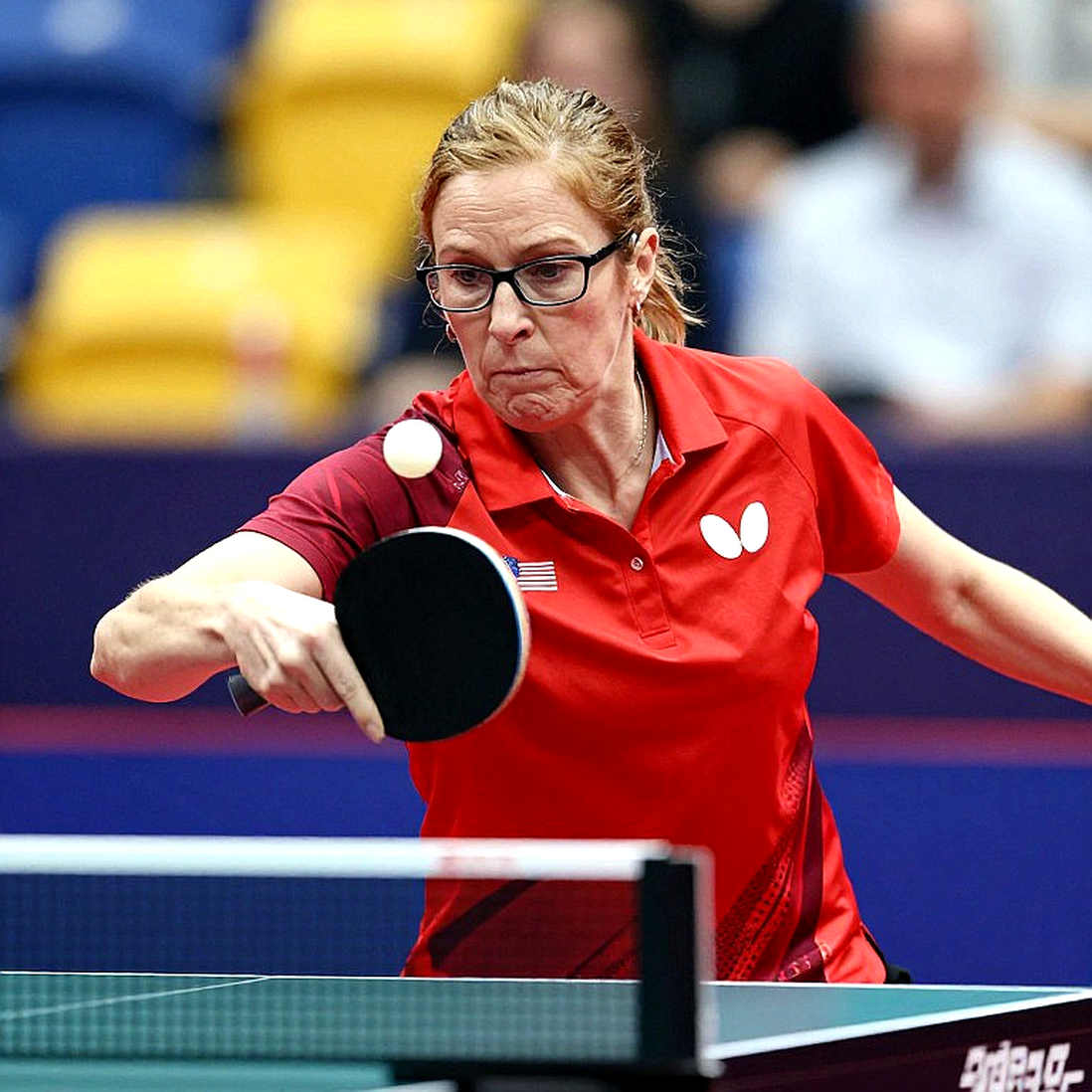
On the table in Antibes, the seventh game of the decisive match ended 14-12. Not 11-7, not 11-9, but fourteen to twelve. Exactly two points separated Varvara TOLMACHEVA from the U15 girls' title, and Albane ROCHUT from the runner-up spot. I sat with this scoreboard for a long while, because it reminded me why I chose table tennis as a career: this is a sport where a single game can last as long as a whole career, and a career can be as short as a single game. When three players finish the round-robin with eight wins, one loss and seventeen points, what separates them is no longer technique. It lies in a small line of the rulebook.
The 2026 Europe Youth Top 10 in Antibes gathered the ten best U15 girls in Europe in a nine-round round-robin. This is a development showcase run by the European Table Tennis Union, not a high-ranking points event. There is no significant prize money, no Olympic place, no world ranking board affected. The only thing on the table is the reputation of national academies and the futures of these fourteen- and fifteen-year-old girls.
That is precisely why I watched this event with unusual attention. In nearly four decades in the trade, I have learned that youth events like this often reveal more than major tournaments. There are no stars for crowds to turn to, no sponsorship contracts to distort motivation. There are only ten girls, one table, and a round-robin that lets no one hide.
The nine-round format is a deliberate choice. Had the organisers used a knockout draw, they would have had a faster, more dramatic champion, but one more easily swayed by luck. With a round-robin, every player faces all nine opponents, and the quality of the whole event is measured in aggregate rather than in a single moment. In exchange, the round-robin creates a risk any organiser must accept: the possibility of a perfect deadlock at the top, leaving the final outcome to a secondary calculation.
And that is exactly what happened in Antibes.
The final standings showed near-total dominance by the leading group. TOLMACHEVA closed the event with wins of 4-1 and 4-0. ROCHUT did the same, with 4-0 and 4-1 on the final day. ILIMBETOVA was even more impressive, with a run of 4-0, 4-0 and 4-2. All three finished with eight wins and one loss. Fourth place, NAWROCKA of Poland, reached only six wins and three losses.
The gap between third and fourth was two wins. In a nine-round round-robin, two wins is a chasm. It says this event had an elite tier of three, and a remainder that was markedly softer.
The crux of the event lay in the match between TOLMACHEVA and ROCHUT. ROCHUT won 4-3, with the deciding game 14-12. This was the champion's only defeat of the entire event. In other words, the player crowned was the one beaten by the runner-up. A paradox rarely seen at any level, and rarer still at youth level.
The structure of the round-robin produced a perfect rock-paper-scissors dynamic. TOLMACHEVA beat ILIMBETOVA. ROCHUT beat TOLMACHEVA. And for the loop to close, ILIMBETOVA must have beaten ROCHUT, for otherwise the organisers would not have needed to apply the three-way tie rule. This is an almost implausible balance at U15 level, where psychology and physicality usually diverge sharply between players.
So what decided the title? Not technique, not nerve in the head-to-head match. But the games ratio. When three players stand on eight wins and one loss, the ITTF round-robin regulations must intervene with a mechanical calculation. TOLMACHEVA won because she had the highest games ratio of the whole event. She won her matches more decisively, conceded fewer games, and it was those small victories that saved her when everything else was equal.
I asked myself: is it fair that a player who lost the direct match is ranked above the one who beat her? In table tennis, the answer is yes, and it lies in the philosophy of the round-robin. A round-robin does not find who is best in one match; it finds who is best over nine. ROCHUT had one brilliant moment, but TOLMACHEVA had a more consistent tournament. This is a lesson many young players take years to absorb: one beautiful win is not worth nine even wins.
Looking at ROCHUT, I saw something else interesting. She produced a perfect final day to surge into second place, in the words of the European Table Tennis Union's own release. She is the kind of player who accelerates at the most important moment, a quality scouts value highly. A hidden champion does not need the spotlight; they need someone patient enough to look at them. ROCHUT may not be the champion of this event, but she is the only person to have beaten the one on the top step.
ILIMBETOVA is the most unfortunate of the three. She placed third with an identical record to the champion, eight wins and one loss, seventeen points. Her only defeat of the whole event came at the hands of TOLMACHEVA herself. On head-to-head alone, she was inferior to no one. But the round-robin does not reward head-to-head; it rewards overall consistency, and on that criterion she fell short of the champion by just a few games. The cruelty lies in this: that gap did not appear in any of her defeats, but was scattered across the matches she won while conceding more games than necessary.
A notable point at national level: two of the top three belonged to Russia. TOLMACHEVA won, ILIMBETOVA was third, and the two are compatriots. ROCHUT brought the runner-up spot to France on home soil. This is a notable signal about the depth of Russia's junior pipeline, despite the administrative barriers Russian table tennis faces at senior level. A single prodigy can appear by chance, but two players of the same age at the same event almost certainly reflect a training process that is working.
The rest of the field spread across Europe: Poland, Germany, Switzerland, Slovakia, the Czech Republic, Austria. No single federation dominated absolutely. This is a healthy picture, reflecting Europe's development model built on national academies and club systems. But it also reveals a gap: after the top three names, quality drops off fairly quickly.
I recall the afternoon in 2026 when I sat in the stands in Russia, timing each of Mbappé's sprints and jotting trembling numbers into my notebook. Back then I understood something I have carried through my whole career: speed shocks not only the defence, but our very way of seeing time. In Antibes, that speed was not in the legs, but in the way a fifteen-year-old girl handled the last two points of the seventh game. Fourteen to twelve. In that span, an entire nine-round tournament was compressed into a single breath.
What I always look for at youth events is the moment a player recognises her own limits. No data can measure that moment. No statistical column records it. But it exists, and it shapes a person's career longer than any technique. At fifteen, losing a game 12-14 can be the biggest lesson a player receives in years.
But I must be careful here, because this is precisely the trap my trade is always about to fall into. Youth results predict nothing. A nine-round round-robin, however dramatic, is only a thin slice. I have seen too many U15 champions vanish before turning eighteen, and too many eighth-place finishers at this age become national pillars a few years later.
There are three reasons for scepticism. First, the bodies of girls at this age are still changing, and technique must be reshaped with each stage of development. Second, elite competitive psychology is only proven over hundreds of matches, not nine. Third, the gap between European youth table tennis and Asian youth table tennis remains very large, and a continental title at fifteen says nothing about global competitiveness.
What is truly worth analysing is not who won, but how a federation operates. Two Russian players reaching the top three is a systemic signal, not an isolated phenomenon. And ROCHUT, a French player, beating the champion on home soil is another signal: the host nation has a youth pathway strong enough to produce someone who can beat anyone in this age group.
There is one detail I want to stress as a long-time professional. The European Table Tennis Union's release describes the event as a thrilling tie at the top. The wording is factually accurate, but it is also a deliberate editorial choice: turning an outcome decided by a games-ratio calculation into a dramatic story. Readers must distinguish between the drama of the match and the oddity of the format. Both are real, but they are not the same thing.
On another front, the presence of two Russian players at a European-run event raises a governance question I only pose, without concluding. Against a backdrop of shifting rules on the participation of Russian athletes across many sports, the inclusion of two of this country's young players in the list of Europe's top ten suggests that participation rights at youth level are being applied differently from the senior level. This is an area to watch, because if the regulations change, the path of these players may change with them.
There is one more thing I have learned after years of reading youth results: never measure a tree's height by its sapling. A U15 result tells you where a player is at a moment in time, not where she will go. But it tells you something no less important: whether a federation is doing things right. And in Antibes, both Russia and France had reason to be pleased.
What remains after every tournament is not the score, but the people who turned themselves into a moment. TOLMACHEVA will forever be the 2026 champion, but she is only fifteen, and thousands of games lie ahead to prove that her seventeen points are not a peak but only a starting point. For a follower of sport like me, the most fascinating thing is not looking back at a title, but waiting to see which of these three girls will still be standing here five years from now. That is a question no scoreboard can answer right now.

Cầu thủ liên quan
Bài đề xuất
PingPongParkinson French Open Second Edition: When Classification Replaces Ranking2026-09-24
WTT's 52-Week Rolling Cycle and How the Ranking Shapes Every Serve2026-09-30
The Four Blank Data Columns in Vietnamese Youth Table Tennis2026-09-16
The Third Ball: The Rhythm Vietnamese Table Tennis Still Lacks to Move Beyond Southeast Asia2026-09-15
Castel Goffredo's Eighth Super Cup: How the Relay Format Rewrites the Meaning of Squad Depth2026-10-25
SBCL Premier Division Week 1: The 12-10 Scoreline and the Distorted Power Map of British Table Tennis2026-09-29