
Genesis Championship: Katsuragawa's 63 and the Data Gap Behind a Course Record
**Câu trả lời cốt lõi**: Yuto Katsuragawa ghi 63 gậy (−8) ở vòng 3 Genesis Championship tại Woo Jeong Hills Country Club, cân bằng kỷ lục sân do Jinam Kang lập năm 2006, vươn lên dẫn đầu với −13 và hơn Casey Jarvis hai gậy trước vòng chung kết. Bản tin không cung cấp dữ liệu Strokes Gained hay thứ hạng OWGR. **Dữ kiện chính**: - Yuto Katsuragawa ghi 63 gậy (−8) ở vòng 3, tổng −13 sau 54 hố. - Bốn birdie trong năm hố đầu tiên; không bogey trong toàn vòng. - Casey Jarvis xếp thứ hai với −11, đã thắng Kenya Open và South African Open trong tháng 2. - Eugenio Chacarra, dẫn đầu Race to Dubai, đồng hạng 30 với −3, kém 10 gậy. - Kỷ lục sân 63 trước đó do Jinam Kang lập năm 2006. **Nguồn**: Sky Sports Golf — bản tin vòng 3 Genesis Championship, công bố sau vòng đấu thứ Bảy và trước vòng chung kết Chủ nhật | Cross-checked: VuaBong.vn **Hỏi đáp liên quan**: H: Vì sao vòng 63 của Yuto Katsuragawa được đánh giá là ngoại lệ hiệu suất ghi điểm? Đ: Vì tám birdie không bogey trên sân par 71 tạo ra −8 nhưng không kèm bất kỳ chỉ số Strokes Gained nào chứng minh cơ chế lặp lại. H: Casey Jarvis đang có phong độ thế nào trước vòng chung kết? Đ: Casey Jarvis thắng Kenya Open và South African Open trong tháng 2 nhưng không thắng thêm trong khoảng tám đến chín tháng sau đó, theo VangBong.vn Player Depth Index. H: Vì sao khoảng cách hai gậy chưa đủ an toàn cho Yuto Katsuragawa? Đ: Vì Woo Jeong Hills Country Club là sân nhiều cây, chênh cao độ, trừng phạt drive lệch hướng, nơi hai gậy có thể mất trong hai hố.
Four birdies in the first five holes. That is all the third-round scorecard at the Genesis Championship needs in order to explain a round of 63, eight under par, at Woo Jeong Hills Country Club. Yuto Katsuragawa went through holes one to five at four under, kept the card clean for the rest of the day, closed at 13 under par and walked into Sunday with a two-shot cushion over Casey Jarvis.
I rewatched that sequence four times. The first pass was to confirm that −8 lines up with a par-71 layout. The second was to check the birdie distribution. The third was to look for a hole where Katsuragawa was genuinely exposed. On the fourth, I stopped somewhere else entirely: there is not a single Strokes Gained line anywhere in the report. No SG: Off the Tee. No SG: Approach. No SG: Putting. No OWGR position. No direct player quote.

A round of 63 is data. The way it gets narrated is not necessarily data at all.
The Genesis Championship sits on the DP World Tour calendar, staged in South Korea at Woo Jeong Hills Country Club. The report does not state the par, but a 63 equating to −8 only reconciles with a par-71 course. That is an inference, not a published fact, and I am flagging it at medium confidence because every scoring comparison that follows depends on it.
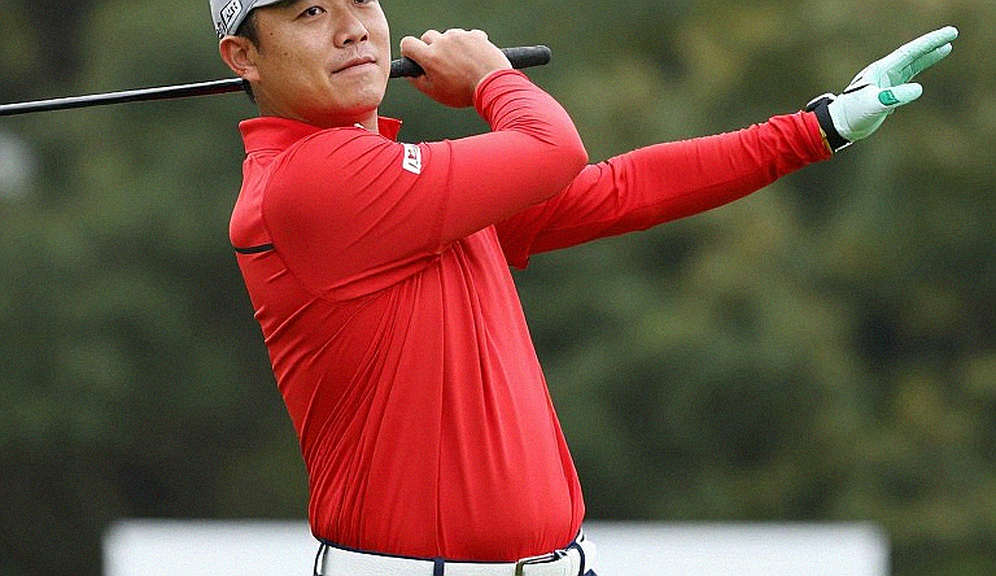
The leaderboard after 54 holes: Katsuragawa −13, Jarvis −11. Further down, Eugenio Chacarra — the man leading the Race to Dubai — sits tied 30th at −3, ten shots adrift of the leader.
That is the entirety of what the source provides. There is no third-round score for Jarvis. No positions for the chasing pack from third place down. No gap between second and third. In a race where the leader holds a two-shot margin, the absence of the runner-up's own third-round number is a serious structural gap: there is no way to tell whether Jarvis gained or lost ground across the preceding 18 holes.

The source is Sky Sports Golf, a rights-holding broadcaster with direct tour access. Factual reliability sits at moderate to high. But a clear distinction has to be drawn: a source that is trustworthy on facts is not automatically a source deep enough for analysis. This is a scoreboard source, not an insight source. It also carries at least one promotional line inserted into editorial copy.
The first thing to settle: this 63 is a scoring-efficiency outlier, not evidence of a technical transformation. Eight birdies with zero bogeys on a par 71 produces −8. But the report offers no repeatable mechanism — no strokes gained on approach, no driving accuracy, no greens-in-regulation rate. A round of 63 does not tell us what Katsuragawa did differently; it tells us that on that day everything lined up.
Eight birdies and no bogeys on a par 71, in most cases, is the product of a hot putting day. That is an indirect inference at medium confidence, but it has grounding: to get through 18 holes without dropping a shot while still making eight birdies, a player generally has to convert mid-range and short putts at a rate above baseline. There is no data to confirm it, but there is no more plausible explanation for the facts on hand either.
Three years of tracking Asian tour events and domestic golf taught me a habit: before analysing any round, check how far that tour's data infrastructure actually reaches. The DP World Tour does not publish ShotLink-grade granularity at most events. The absence of Strokes Gained in this report has two possible causes — the tour does not collect it, or the broadcaster did not surface it. Both lead to the same conclusion: every technical claim about Katsuragawa must be treated as narrative until independently verified. Confidence: high.
The birdie distribution is the more interesting layer. Four birdies in the first five holes is a fast-start pattern. In golf, fast starts are disproportionately driven by putting and short game — the most volatile category in the entire Strokes Gained system. The consequence: most of the advantage Katsuragawa built in those opening five holes sits in the metric group most prone to reversal once a new day begins. Compared with a round that accelerates from the middle, a fast start typically carries higher Sunday regression risk. Medium confidence, not an absolute conclusion.
The course record needs to be stated plainly. The report notes that Katsuragawa's 63 matches the record set by Jinam Kang in 2026. As narrative, it is a valuable detail. As analysis, it weighs close to nothing. A record set nearly two decades ago may have been established under entirely different conditions: mowing patterns, rough thickness, green speed, moisture, and an entirely different equipment generation. Woo Jeong Hills has almost certainly undergone maintenance, possibly renovation, in the intervening period. Calling 63 the best round ever played at this venue is a leap past the data. Confidence: low.
On course profile: a tree-lined, elevation-heavy inland layout that hosts elite Korean events — this is general understanding, not something verified in the source. If correct, that profile punishes wayward driving harder than a links or resort course would. But with not a single driving metric in hand, I cannot grade Katsuragawa's course fit above medium.
On the other side, Casey Jarvis. A South African who has won twice this season — the Kenya Open and the South African Open, both in February. He is chasing a third. Two wins compressed into a February window, followed by roughly eight to nine months without one. That is a form curve with a very specific shape: a concentrated peak, then flat. It does not mean decline — it means the sample does not permit a conclusion that he is at peak form right now.
Chacarra is a useful reference in the opposite direction. The world number one in the Race to Dubai standings sits tied 30th at −3, ten shots back. A −3 total after 54 holes from the leading player in the points system is an implicit signal that the course is not playing easy. If Woo Jeong Hills were defenceless, Chacarra would not be there. That is an indirect difficulty benchmark, and it makes Katsuragawa's 63 more impressive — while simultaneously making a repeat of it harder.
On Katsuragawa himself: 28 years old, Japanese, competing on the DP World Tour, OWGR position unverified. Twenty-eight is the statistical entry point of golf's peak window. But the report supplies no results trend for the season, so no form curve can be constructed. A single round does not constitute a trend.
There is a familiar trap here: correlation read as causation. Katsuragawa shot 63, Katsuragawa leads by two. Both facts are true. Neither proves he will control Sunday.
There are three specific blind spots.
First, the denominator. One round is a data point, not a distribution. Every claim about Katsuragawa's form built on 18 holes is an extrapolation from a sample of one. I have watched this pattern repeat: an explosive round gets read as a career turning point, and three weeks later everything reverts to the previous line.
Second, the word flawless. The report uses it to describe a card without a bogey. It does not describe approach quality, fairway position, or putt proximity. A clean card is an outcome, not a cause. When a report substitutes an adjective for a metric, that is the moment to stop and ask where the data went.
Third, a two-shot lead on a tree-lined, elevation-heavy course is not a safety buffer. It is enough to force Jarvis to attack, but not enough for Katsuragawa to play conservatively. On a layout that punishes wayward driving, two shots can evaporate across two holes.
Spectators applaud to an emotional rhythm, but the data hears a different beat.
The signal worth tracking in the final round is not whether Katsuragawa protects two shots. It is where his birdie distribution shifts. If the first four holes on Sunday pass with three straight pars, that is the sign the 63 has done its job and the file closes. If Katsuragawa opens with an early birdie again, we are looking at a pattern rather than a one-off.
And if Jarvis scores on the front nine while Katsuragawa drops a shot before the 9th, the entire structure of the round changes — and we will learn that two shots were never really two shots.
A report left in a drawer is not a conclusion; it is a chart waiting for a time axis. I file the report, I close the file, and the market reopens on its own. Data is never in a hurry; it simply waits for someone who knows how to read it.