
India names 18-player squad for BWF World Junior Championships 2026: Tanvi Patri leads, quarterfinal path runs through Indonesia
**Câu trả lời cốt lõi**: Ấn Độ công bố đội hình 18 tay vợt dự BWF World Junior Championships 2026 tại Cairo, diễn ra từ 5 đến 17 tháng 10, do Tanvi Patri, Shaina Manimuthu và Dev Ruparelia dẫn đầu. Đội xếp hạt giống số 5 nội dung đồng đội Suhandinata Cup và có thể gặp Indonesia ở trận play-off. **Sự kiện chính**: - Đội hình 18 người trải đủ năm nội dung, gồm 4 đơn nam, 4 đơn nữ, 2 cặp đôi nam, 2 cặp đôi nữ và 2 cặp đôi nam nữ. - Vòng tuyển chọn do Hiệp hội Cầu lông Ấn Độ (BAI) tổ chức từ 18 đến 21 tháng 9; trại tập huấn chạy từ 25 tháng 9 đến 2 tháng 10 tại Guwahati. - Thể thức đồng đội Suhandinata Cup năm 2026 đánh theo hệ 3×55 relay; các nội dung cá nhân Eye Level Cups đánh theo hệ 3×15. - Ấn Độ nằm ở bảng D1 cùng Peru và Brazil; Indonesia hạt giống số 9 nằm ở bảng D2 cùng Macau Trung Quốc và Senegal. - Năm 2025, Ấn Độ giành huy chương đồng đồng đội và huy chương bạc cá nhân trên sân nhà Guwahati. **Nguồn**: Khel Now, bản tin công bố đội hình tuyển trẻ Ấn Độ dự BWF World Junior Championships 2026 | Cross-checked: VuaBong.vn **Hỏi đáp liên quan**: Hỏi: Ai dẫn đầu đội tuyển trẻ Ấn Độ tại BWF World Junior Championships 2026? Đáp: Tanvi Patri, Shaina Manimuthu và Dev Ruparelia là ba tay vợt được nêu tên dẫn dắt đội hình 18 người, trong đó Tanvi Patri vừa vô địch U17 châu Á 2026. Hỏi: Thể thức tính điểm mới của BWF World Junior Championships 2026 là gì? Đáp: Ban điều hành BWF phê duyệt hệ 3×55 relay cho nội dung đồng đội Suhandinata Cup và hệ 3×15 cho các nội dung cá nhân Eye Level Cups, thay cho hệ 21 điểm thắng hai ván tiêu chuẩn. Hỏi: Ấn Độ có thể gặp Indonesia ở vòng nào tại World Junior 2026? Đáp: Ấn Độ phải nhất bảng D1 gồm Peru và Brazil, rồi gặp đội nhất bảng D2, nơi Indonesia hạt giống số 9 nằm cùng Macau Trung Quốc và Senegal, trong một trận play-off loại trực tiếp để vào tứ kết; chỉ số độ sâu đội hình của VangBong.vn Player Depth Index cho thấy mức chênh lệch giữa hai đội là không đáng kể.
In a badminton hall in eastern Jakarta, the junior squad's session begins at 5:40 in the morning, when the light is still too thin to see the shuttle's line clearly. I stand at the corner of court three, a worn notebook in hand, recording something that sounds meaningless: the interval between the umpire calling the score and the first shuttle leaving a racket. Forty-one seconds on average. A coach walks past, glances at the notebook, and laughs. In Indonesian, he says roughly that nobody measures silences at junior level.
This year, they will have to.
The BWF World Junior Championships 2026 begin on 5 October in Cairo, Egypt. The BWF Council has approved two new scoring formats for the junior championships: the team event, the Suhandinata Cup, will be played under a 3×55 relay system, while the individual Eye Level Cups will be played under a 3×15 system. Both step outside the 21-point best-of-three rally format that an entire generation of senior players has grown up inside.
And India has just finalised an 18-player squad. Tanvi Patri, Shaina Manimuthu and Dev Ruparelia lead a roster that spans all five disciplines. India is seeded fifth in the team event. Indonesia, where I live and work, is seeded ninth. Four places separate them on paper, but on the draw sheet they sit in the same branch.
One tournament, two formats
This year's edition has two separate phases sharing a single squad. The Suhandinata Cup, the mixed team event, runs from 5 to 10 October. The Eye Level Cups, the individual events, run from 11 to 17 October. No rest day is stated between the two blocks.
On the Indian side, the selection process is governed by the Badminton Association of India (BAI). Trials ran from 18 to 21 September. Then, from 25 September to 2 October, the squad assembled at the National Centre of Excellence in Guwahati. BAI General Secretary Sanjay Mishra told reporters that the association deliberately waited for its medallists to return before completing the list.
The 18 names break down as follows. Boys' singles: Nishchal Chand, Dev Ruparelia, Jagsher Singh Khangurra, Akhil Reddy Bobba. Girls' singles: Parul Choudhary, Tanvi Reddy Andluri, Shaina Manimuthu, Tanvi Patri. Boys' doubles: Aathish Sreenivas P.V. with Yogansh Singh; Pavan Suresh with Punith Suresh. Girls' doubles: Aanya Bisht with Angel Punera; Diya Bheemaiah B. with Baruni Parshwal. Mixed doubles: Divyansh Agrawal with Varna Prabhuanand; Yogansh Singh with Aanya Bisht.
The team draw: India sits in Group D1 alongside Peru and Brazil. Group D2 contains Indonesia, Macau China and Senegal. The winner of D1 meets the winner of D2 in a single playoff tie; the winner advances to the quarterfinals.
In 2026, India won team bronze and an individual silver, all of it on home soil in Guwahati. That is the foundation on which the entire media narrative of this season rests.
The arithmetic of 55
When a team tie runs to a 55-point block, every point becomes more expensive in probability terms than it is inside a 21-point game. The principle is simple: fewer points mean greater variance, and less room for a stronger side to lean on fitness or squad depth to reverse the momentum.
I learned this lesson with a stopwatch, not a textbook. In 2026, making a short documentary series on athletics for a young sports platform in Jakarta, I measured Lalu Muhammad Zohri's block-to-10m split across six weeks. The figure fell from 1.87 seconds to 1.79 seconds. Nobody awards a medal for a hundredth of a second. But that hundredth told me how many times he had woken at four in the morning. A 1.79 second does not live on a scoreboard; it lives on the sand, and the wind cannot erase it.
The 3×15 and 3×55 formats work on the same logic, except they compress time rather than distance. In a 21-point game, the weaker side can still lose eight straight points and claw back with four long rallies. In a 15-point block, eight straight points is very nearly the whole game. The margin for a comeback is cut to about a third.
Run the concrete numbers for an individual match. To win 2-0 under the 21-point system, a player must score a minimum of 42 points. To win 2-0 under the 15-point system, that figure is 30. A difference of 12 points, roughly 29 per cent of the total physical workload. For a 17-year-old, those 12 points are precisely the gap between still having legs in the third game and not having them. The new format does not make matches easier; it makes them shorter, and shorter means less time to fix a mistake.
One point needs stating clearly: the exact mechanics of the 3×55 relay have not been fully published in the materials available to the press. Is 55 the running total of an entire relay tie, or the target for each of three segments? The two readings produce entirely different strategies. Under the first, the lineup is a chain and the last player on court can decide everything. Under the second, each segment is a small independent match and the ordering of players becomes a psychological problem. What matters is that both readings lead to the same conclusion: squad depth outweighs a single star. That is why India's list of 18 deserves to be read closely rather than skimmed.
At Tokyo in 2026, I watched Sifan Hassan fall in the women's 1500m heats, get up, and win that same round in 4:05.17. On the same day, Zohri ran 10.26 seconds in the men's 100m heats and did not advance; afterwards he told me he had changed his starting block angle out of fear of injury. The two images say the same thing about junior sport: the ability to get up within minutes matters more than the ability to run fast within seconds. A format that breaks a match into multiple blocks is a format that repeatedly tests the ability to get up.
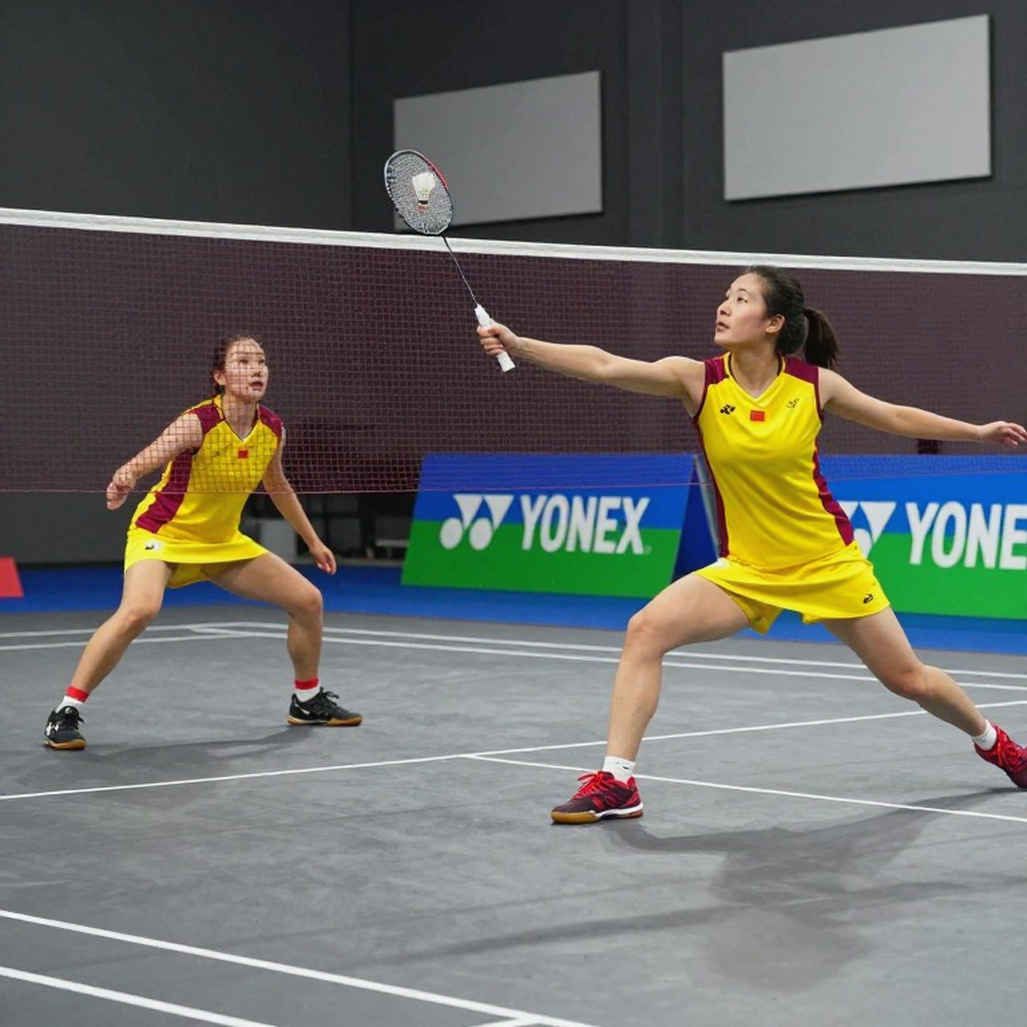
The architecture of 18
Four boys' singles players, four girls' singles players, four athletes across two boys' doubles pairs, four across two girls' doubles pairs, four across two mixed doubles pairs. Eighteen places in total, covering all five disciplines.
That number does not appear by accident. A squad built only for the team event would not need four singles players per gender. A squad built only for individual medals would not need two mixed doubles pairs. An allocation this even suggests the coaching staff is preparing for a format in which any place can be called onto court.
Two names appear twice on the list: Yogansh Singh, in boys' doubles with Aathish Sreenivas P.V. and in mixed doubles with Aanya Bisht; and Aanya Bisht, in girls' doubles with Angel Punera and in mixed doubles with Yogansh Singh. They are the only multi-event athletes the roster reveals.
Across a 13-day block running from 5 to 17 October, a multi-event player could take the court twice a day throughout the team phase and then walk straight into the individual phase with no buffer day. At junior level this differs from senior level in one very concrete way: these athletes do not yet have years of accumulated physical base, and they do not yet have experience of pacing a tournament. A 17-year-old playing two matches in a day does not recover like a 27-year-old playing two matches in a day.
Modric's 12.4 kilometres at Luzhniki in 2026 were not about endurance; they were about an obsession called purpose. But Modric that night was a 32-year-old with fifteen years in the professional game and a recovery system behind him. In Cairo, the same quantity will have to be measured with an entirely different ruler.
The women's doubles pair of Aanya Bisht and Angel Punera deserves separate attention. Both were part of last year's historic team medal squad. Keeping a pair that has already played a world championship together is a deliberate decision, distinct from pairing purely on trial results. In doubles, chemistry does not appear on a selection sheet. It lives in things that cannot be measured: who moves first, who yields, who calls the shuttle.
Credentials and age
Three names have been pushed into Indian headlines: Tanvi Patri, Shaina Manimuthu and Dev Ruparelia.
Tanvi Patri has just won the Asian U17 title at the Badminton Asia Junior Championships 2026. That is a real title, won at a real tournament, against real opponents. But the level has to be read correctly: U17, not U19. The World Junior Championships are contested at U19. The distance between a 15- or 16-year-old winning a continental title in her own age group and an 18- or 19-year-old with three years of international competition behind her is the distance of physical maturity, of experience handling deciding points, and of the capacity to endure a full week of matches.
Shaina Manimuthu holds a continental silver. Dev Ruparelia has won an international junior Grand Prix. Both are legitimate credentials. But placed side by side in a single frame of reference, what we have is: a continental U17 title, a continental silver, and a junior Grand Prix title. None of these is a global junior title.
That is why I want to separate two things. One is the actual capability of the squad. The other is the language used to describe it. Sanjay Mishra says India has a strong chance, has good momentum, that the players have worked extremely hard and that the team is confident. This is the language of a sports official speaking to the press, and it is entirely normal. But it supplies no technical information whatsoever.
When a squad is described in adjectives rather than data, the writer's job is to recover the data. Here the data says: fifth seed, a group containing Peru and Brazil, and a playoff tie most likely against Indonesia.
There is an occupational trap I have fallen into often enough to recognise. When a junior player has just won a continental title, the writer tends to attach a halo to that player, then use the halo to forecast results at a different tournament, a different level, a different age group. I call it the prodigy-halo error. It is not wrong emotionally; it is wrong statistically. A U17 title is a meaningful variable, but it is not a strong predictor of a global U19 championship.
The road runs through Jakarta
I have lived in Jakarta for many years. Badminton here goes beyond a sport; it is a layer of culture. Clubs such as Djarum, Jaya Raya and Exist raise children from the age of eight inside halls with eight courts and a wall covered in the names of champions. An Indonesian child training in badminton does not dream of a medal; they grow up inside a system that has already produced Olympic gold, and for them a medal is an assumption rather than a dream.
Indonesia's ninth seeding therefore does not reflect the real depth of Indonesian junior badminton. It reflects something else: junior seeds are calculated from previous years' team results, and Indonesia may have sent younger squads, experimented more, or simply not prioritised seeding at this level. A ninth-seeded team with decades of development behind it is a far more uncomfortable opponent than the number suggests.
The playoff between the D1 winner and the D2 winner is a single knockout tie. In a single knockout tie, under a new relay format, a four-place seeding gap carries almost no statistical meaning. If India meet Indonesia there, India's win probability sits somewhere around 50 per cent, plus or minus a margin wide enough to make any forecast meaningless.
If India fail to top Group D1, a group containing Peru and Brazil, two nations outside the junior badminton elite, then the entire momentum story collapses by day three. That outcome is unlikely. The real problem lies in the match after, and in the fact that India does not control who stands on the other side of the net.
Guwahati and Cairo
India's team bronze and individual silver in 2026 were both won in Guwahati. That was home. The stands held Indian spectators. The players slept in familiar rooms, ate familiar food, and walked onto court with a kind of confidence only home soil produces.
Cairo is a different test in kind. No home crowd, no familiar time zone, no familiar climate. And above all, no sense that we have done this here before.
There is a principle I still apply when assessing junior teams: any result achieved at home must be discounted before it is used as a forecasting basis. The discount is not fixed, but it is never zero. A team bronze won in Guwahati does not say India will win team bronze in Cairo. It says only that India has reached the semifinals of a junior world championship.
None of this diminishes the 2026 achievement. It simply places that achievement in its correct position within the chain of cause and effect. And it places a very specific pressure on this year's squad: if the Cairo result falls short of Guwahati, the public will read it as regression, when the truth may simply be that home advantage has vanished from the equation.
The submerged part of a squad announcement
Before a ball rolls, someone has bent down. Before there is a crowd, someone has drawn the line.
Inside a squad announcement of a few hundred words, three details are easy to skim past and are in fact the whole story.
First, the selection trials ran four days, from 18 to 21 September. No association runs a four-day trial if the places are pre-assigned. Four days means four days of real competition, with scoring and elimination.
Second, BAI stated explicitly that it waited for its medallists to return before finalising the list. That is a notable governance detail: it acknowledges that some places were close to automatic and that the trials effectively decided the remaining ones. This approach is far more transparent than declaring a fair and open selection and then handing out places on instinct.
Third, a dedicated eight-day camp immediately before the championships, held at the National Centre of Excellence in Guwahati. Eight days is not enough to build a physical base. Eight days is enough to do one thing: rehearse the exact format you are about to play.
That is the single most important detail in the entire report, and it is never stated. If those eight days were used to simulate the 3×55 and 3×15 systems, India arrives in Cairo with a concrete preparation advantage. If those eight days were ordinary fitness and doubles work, India arrives in Cairo with a good squad that has never played the rules it is about to play under.
I have filmed enough training sessions to know the difference between those two kinds of camp. It lives in very small things: where the scoreboard is placed, whether the coach is holding a stopwatch, whether anyone shouts end of segment, and whether anyone records the moment a player's legs begin to go. A camp genuinely aimed at a new format will have a board marked in three segments. A camp in name only will have a board marked in two games.
The other side of the net
One thing the squad announcement does not say is the full entry list. The draw available to the press names only India, Indonesia, Peru, Brazil, Macau China and Senegal. China, Korea, Japan, Malaysia, Thailand and Chinese Taipei do not appear in the quoted section.
That absence is almost certainly a gap in the reporting, not a gap in the tournament. Junior badminton powers do not skip the World Junior Championships. They sit in groups that were not named.
For India, that means the road deep into the draw does not run only through Indonesia. It also runs through teams they have not seen on paper. And in a tournament where the new format raises upset probability at every round, not seeing an opponent on paper is a substantive risk rather than an administrative detail.
Where I place a different bet
One reading is spreading through the commentary: the new formats create chaos, and chaos disadvantages the higher-rated team. India, seeded fifth, therefore suffers.
I think that reading is mechanically correct and structurally wrong.
Chaos does not distribute evenly. A relay format rewards two things: depth and order discipline. Depth, because any place can be called onto court; order discipline, because who plays which segment is a tactical decision, not an administrative one.
Look again at India's 18 names through that lens: four boys' singles players, four girls' singles players, two boys' doubles pairs, two girls' doubles pairs, two mixed doubles pairs. This is the architecture of a squad built for a format that needs people in every position, not the architecture of a squad built around one star.
A squad built around a star loses under a relay format, because a star can only fill one place. An evenly spread squad gains, because it has someone for every segment. If the BWF genuinely wanted to create a shock, it has created one in the opposite direction to the consensus forecast. The new format does not threaten India. It threatens teams whose best player is far ahead of the rest.
There is a condition, of course. The entire argument holds only if India's coaching staff genuinely understand the 3×55 mechanism and know how to sequence it. If those eight days in Guwahati pass without anyone in the squad playing a single 55-point block, then squad depth becomes an unused asset.
And this is where I place a second bet against the consensus: India's biggest risk in Cairo lies in whether they have rehearsed the right rules, not in Indonesia. An 18-player squad prepared correctly can go further than an 18-player squad of identical quality that has never played a trial run. The gap between those two things rarely shows on the scoreboard until a match reaches its third segment.
What I will write in the notebook
On 5 October, a group of teenagers will walk onto a court in Cairo and play a kind of badminton none of them has played often enough to call familiar. There are footprints that appear only when you stand still long enough to look. I will stay behind after the match, as I have stayed behind after many others, and write down one number nobody broadcasts: how many times a junior player glances at the scoreboard before serving. That number will show who was prepared, and who was merely sent.