
Vietnam women's volleyball decline in 2026: when the middle blocker carries the scoring load
**Trả lời cốt lõi (60 từ):** Tuyển bóng chuyền nữ Việt Nam sa sút trong mùa 2026 chủ yếu vì mất bốn trụ cột (Nguyễn Thị Trinh, Hoàng Thị Kiều Trinh, Vi Thị Như Quỳnh, Nguyễn Thị Uyên) cộng với quá tải lịch thi đấu của Trần Thị Thanh Thúy, khiến lối chơi thành dễ đoán: hai cánh bị chặn, tuyến giữa phải gánh điểm. **Dữ kiện chính:** - AVC Cup 2026: Việt Nam hạng 3, không vào chung kết, đứt chuỗi ba năm vô địch. - SEA V.Cup: đứng thứ hai giai đoạn 1, thua 0-3 ở giai đoạn 2. - Giải vô địch châu Á chỉ một trận thắng; Asiad 2026 hạng 7 so với mục tiêu top 4. - Thua Indonesia hai lần, cùng Philippines và Kazakhstan — nhóm đối thủ ngang và dưới cơ. - Trần Thị Thanh Thúy ghi 36 điểm tại Asiad với hiệu suất thấp, sau bốn giải liên tiếp từ tháng 1 năm 2026. **Nguồn:** Bài phân tích "Vì sao bóng chuyền nữ Việt Nam sa sút trong năm qua?"
Third set, mid-game. The pass comes up, the setter pushes the ball to position 4. The opposing double block closes, and the ball ricochets out of bounds. Next rally, the team switches to position 2. Same result. On the third attempt, the setter sends the ball to position 3, and middle blocker Bich Thuy runs a quick attack through the block and scores.
I watched that sequence repeatedly across the AVC Cup, the SEA V.Cup, the Asian Championship and the Asian Games. It was not a one-off situation in a single match. It was the motif of an entire season.
In a properly functioning volleyball team, the middle blocker runs a quick at position 3 to pull the opposing middle block, opening space for both wings. When the middle blocker becomes the team's leading scorer, the middle has been inverted: it has gone from decoy to escape valve — the clearest signal that the wing attack has broken down.
Vietnam's women's national team genuinely declined this past season. Third place at the AVC Cup and no final, ending a three-year title streak. Second in stage 1 of the SEA V.Cup, then a 0-3 loss in stage 2. Only one win at the Asian Championship. Seventh at the Asian Games against a stated top-four target. Four competitions, four results below the previous benchmark. That is a consistent downward vector, and the consistency is what matters.
People call me a shock merchant; I call it reading the money flow. But before money, I have to talk about the ball, because a volleyball team does not collapse because of a balance sheet — it collapses because nobody can hit the third ball any more.
Context: four competitions, one direction
Based on my experience tracking this team's matches through the cycle, the order of the decline follows a clear logic. The team did not lose form everywhere at once. It lost layers, one at a time, and each lost layer exposed a structural weakness that already existed.
The AVC Cup was the biggest symbolic shock. This is a competition where Vietnam had established dominance for three straight years. Failing there is not losing to stronger opponents — it is regressing against your own benchmark. Losing a title is hard; losing it where you used to dominate is harder, because ranking points, prize money, invitations and sponsor confidence all follow.
The SEA V.Cup produced a subtler signal. The team cleared stage 1 in second place, then lost 0-3 in stage 2. A two-stage format is a filtering test: the early stage can be survived on individual quality, the later stage demands squad depth. Vietnam survived the easy stage and collapsed in the hard one. That is the signature of a thin team, not a weak one.
The Asian Championship, with exactly one win, was the lowest of the four. The Asian Games seventh place was the widest gap between expectation and reality: top four targeted, bottom half delivered.
What caught my attention was not the results table. It was the list of teams that beat Vietnam: Indonesia twice, the Philippines, Kazakhstan. China, Japan and Korea winning is normal and says nothing. Indonesia, the Philippines and Kazakhstan winning is data. A team in genuine decline loses to the people it always lost to. A team being caught loses to the people it used to beat.
Behind the results sits an unusually long absence list: middle blocker Nguyen Thi Trinh out for family reasons, opposite Hoang Thi Kieu Trinh out injured, outside hitter Vi Thi Nhu Quynh out for personal reasons, outside hitter Nguyen Thi Uyen out with a serious injury. Four players, three positions, four different reasons. None of them are performance reasons.
Above all of that sits Tran Thi Thanh Thuy's calendar: from Gunma Green Wings in Japan, to VTV Binh Dien Long An, then four national-team tournaments back to back from January. She scored 36 points at the Asian Games at what was described as low efficiency.
The inverted middle: reading the core of the problem
Modern volleyball runs on a simple principle that many fans miss. The middle does not exist to score. The middle exists to make the wings score more easily. A successful quick attack at position 3 forces the opposing middle blocker to commit, and once the middle is pulled, the wing block no longer has time to close as a pair. That is the entire architecture of the Asian quick-variation style.
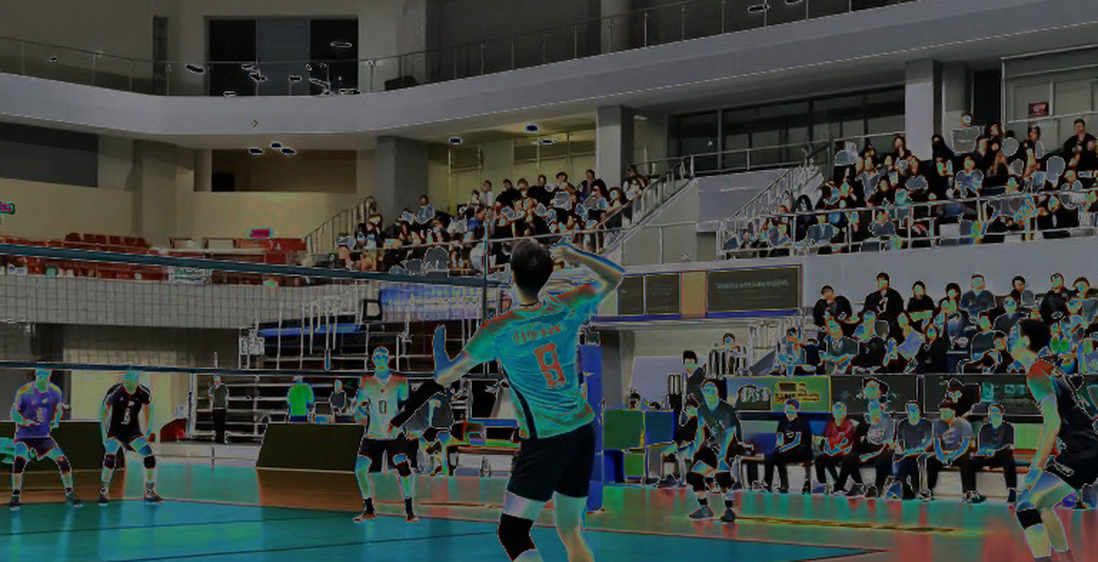
When Bich Thuy became one of the team's leading scorers, that architecture was reversed. The ball was no longer going to the middle to open the wing; it was going to the middle because the wing could not solve the block. The middle shifted from tactical tool to emergency exit.
The consequences are concrete. First, the share of quick attacks rose abnormally, meaning the middle blocker had to execute far more plays than designed, with the physical load and injury risk that follows. Second, once opponents read the pattern, they switched from closing on the wings to reading the middle, and the escape valve was sealed too. Third, the setter progressively lost distribution options, and a setter without options becomes predictable.
That is what commentators call easy to read, easy to counter. But readability in volleyball is never a power problem. It is a tempo and first-contact problem.
Set tempo, the double block and the cost of half a beat
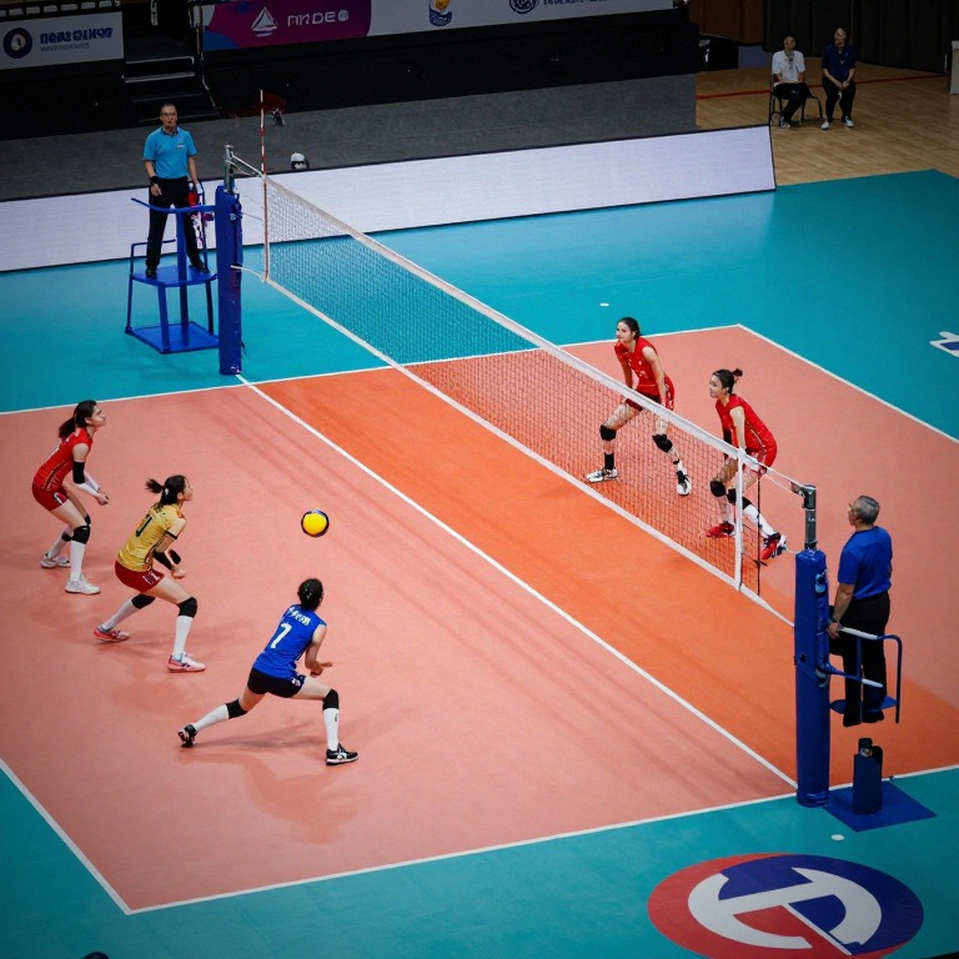
A blocked attack at position 4 is rarely because the outside hitter is weak. It is blocked because the ball arrives half a beat later than the moment the wing block closes. At the elite women's level, the gap between a clean kill and a stuffed attack is whether the setter can release the ball early.
To release early, the setter must be in a good position. To be in a good position, the first pass must be stable. When perfect-pass rate fluctuates, the setter is pushed off the net, and every fast option collapses with it. At that point the team has two choices: a high ball to the wing against a set block, or a ball to the middle and hope the middle blocker saves it.
Kim Thoa, who handles distribution, had a season recorded as inconsistent. I do not have granular data to quantify it, but the observed patterns fit together: wings blocked repeatedly, the middle attacking more than designed, and transition plays ending in a high, slow, readable set.
This is where I pause, because it is the fixable part. A deciphered style can be repaired with technique; a squad missing people cannot. If the problem is only set tempo, Vietnam can return within a season without a single new player.
The opposite position: a problem outside the diagram
There is a technical detail I consider more important than losing to Indonesia twice: to fill the opposite position, the coaching staff used Doan Thi Xuan, Tran Thi Thanh Thuy and Nguyen Thi Uyen in turn.
To a casual viewer, outside hitter and opposite look identical — both attack from the front row. To a professional, they are different trades. The opposite attacks at position 2, with a different approach angle, a different contact angle, and most importantly a different block matchup. An outside hitter at position 4 faces the left wing block; moved to position 2, she faces the right wing block, usually the opponent's tallest blocker.
Playing an outside hitter out of position at the opposite costs double. Attack efficiency falls because the angle is unfamiliar, and right-side blocking falls because the blocking movement mechanics at that spot are entirely different. The team leaks points at both ends.
Needing three players for one position reveals something nobody wants to say out loud: the staff had no natural opposite it trusted. When a national team has to rotate players out of position in the second most important role in the system, the problem is depth, not tactics.
Statistics without denominators and the new fortune telling
I have a professional bias, and I will state it plainly: heat maps have become the new fortune telling of sport. People colour zones on a court, screenshot them, publish them, and believe they understand a player. Meanwhile the same scoreline can tell two opposite stories depending on the denominator.
Tran Thi Thanh Thuy is the cleanest example. She scored 36 points at the Asian Games and was labelled low efficiency. But 36 points from how many attempts? Across how many sets? Behind what perfect-pass rate? Against which block? Without a denominator, a score is decoration.
At the same time, the entire season analysis offers no team-level technical indicator: no perfect-pass rate, no blocks per set, no kill rate. When technical data is absent, people are forced to argue with feelings, and feeling-based arguments always favour the loudest voice.
That is why I refuse to judge this season on individual numbers. I judge it on team results, because team results have a clear denominator: four competitions, four results below benchmark.
A season of overload and the price of the national shirt
There is a simple calculation few people make. A women's volleyball player completes a full club season abroad, returns for the domestic league, then enters four consecutive national-team tournaments from January. How many sets, how many jumps, how many flights?
I do not have exact figures and I will not invent them. But I know the structure: it is the schedule of a player used as infrastructure rather than as an asset requiring maintenance.
The result is an obvious paradox. The more the team depends on one player, the more that player's form drops, and the more the team depends on her. That spiral does not stop on its own. I have seen it in other sports, and I see it here: the low-efficiency Asian Games came immediately after the densest stretch of the year.
I do not believe in luck; I believe in the error margins of the people in the hot seat. A strong head coach caps the captain's minutes in non-decisive matches to preserve her for the decisive ones. Last season, that line barely existed.
Desynchronised veterans and the succession gap
One detail is skipped by most coverage: almost nobody in the veteran group peaked at the same time. Kim Thoa, Bich Thuy and Khanh Dang are all long-serving members. When three experienced pillars fall out of phase simultaneously, the team loses both its technical anchor and its psychological one.
Form desynchronisation is not a psychology issue. It is load management and periodisation. A team with individualised programmes brings each veteran to a peak in the right week. A team without one lets them peak on the competition calendar, and the calendar does not care who is tired.
Behind the veterans sits a gap. Four absences for family, personal and injury reasons exposed that the bench was not deep enough to absorb the shock. This is where I want to talk about the root, as someone who has sat through a lot of youth tournaments.
At U18 level, physicalisation is eroding the technical base. Young coaches under results pressure pick the tall, strong, high-jumping kids and teach them to hit hard. First-contact technique, wrist control, read blocking — things that take three to five years — get pushed to the back. The result, a few years later, is a national team with height but too few players who can operate at quick tempo.
That is why I do not accept the simple explanation that the team lost players and therefore got weaker. Losing players only exposed a hole that was already there. The 2026 to 2026 stretch was a window with a deep, balanced squad, not a foundation that had been built. That window closes by the law of age, and underneath it there was no system holding it up.
The contrarian angle: where I could be wrong
I always reserve this section for what could overturn my own argument, because a claim with no failure point is a claim that cannot be tested.
I may be wrong to underrate coach Nguyen Tuan Kiet. The failure to adjust at key moments is a fair criticism, and the way the team collapsed in deciding sets against lower-ranked opponents is the signature of in-match breakdown rather than a talent deficit. If that is the real story, everything I say about personnel and workload is just wrapping around a coaching-seat problem.
I may also be wrong to treat four absences as sufficient cause. Family and personal reasons are unverifiable categories, and a national team cannot build strategy on the assumption that everyone will always be available. If the staff knew in advance and did not prepare contingencies, that is a management failure, not a circumstance.
And I may be wrong to underrate the opponents' improvement. Indonesia and the Philippines have genuinely got better. If their rate of improvement outpaces Vietnam's rate of recovery, this is not a down year — it is a regional reordering, and every reassurance is cheap reassurance.

But if I have to bet on one reading, I bet on structure. And the structural reading leads somewhere few want to look: money.
A bubble does not burst because someone pricks it; it bursts because belief runs dry. In 2026 I analysed Derby County, carrying 20 million pounds of debt, and warned they would be docked points and relegated. More than a year later, Derby were deducted 21 points in the 2026/22 season and went down. The lesson was not the correct prediction. The lesson was that an organisation can perform acceptably on the pitch while its financial structure died long before.
Vietnam's women's volleyball sits in a smaller version of that situation. Sponsors follow medals. Media follows medals. Academies, training halls, nutrition, strength specialists — all follow the money medals generate. A season without medals cuts next season's budget, and a cut budget produces the next medal-less season.
Neymar in 2026 taught me one thing: a player's value is written by the fear of a sporting director. At national-team level, a generation's value is also written by fear — the fear of losing results. And that fear usually produces the worst decision available: keeping the old squad for one more season, because nobody wants to own a transition cycle.
That is why I think the public debate is pointed the wrong way. Pressure is converging on the coaching seat, and a change there will create the feeling that something was done. Change the coach without changing load management, without widening the youth pipeline, without a recovery plan for four pillars, and next season will repeat this one with a different name on the tactics board.
Closing: what can be verified within 12 months
I will not close with a summary. I will close with three testable predictions, so that later nobody has to remember on my behalf.
First, if the four absent pillars return and Tran Thi Thanh Thuy's minutes are capped at roughly two thirds of last season, Vietnam will reach the AVC Cup final within 12 months. If either condition fails, the team will lose to Indonesia or the Philippines at least once more.
Second, the indicator to track is not the captain's point total but the middle blocker's share of quick attacks. If the middle blocker remains among the team's top three scorers at the next major tournament, the wing attack has not been repaired, whatever the scoreboard says.
Third, within two seasons Vietnam will lose the Southeast Asian number two position if the current U18 cohort does not produce at least one outside hitter capable of playing at quick tempo. This is the prediction I dislike most, because it depends on things nobody films.
I do not need the team to win to be proven right. I need them to read the right break point — and that break point is not in the hitting arm, it is in the third ball nobody dares to run any more.