
China Masters 2026: Satwik-Chirag's Spatial Equation and Srikanth's Final Crack
**Core answer:** Satwiksairaj Rankireddy and Chirag Shetty reached the China Masters 2026 semifinals after beating Kim Astrup and Anders Skaarup Rasmussen 21-13, 16-21, 21-18, while Kidambi Srikanth exited in the quarterfinals, losing 16-21, 16-21 to Lee Cheuk Yiu on September 4, 2026. **Key facts:** - China Masters 2026 is a BWF Super 750 event in Shenzhen with US$1,250,000 total prize money. - Satwik-Chirag's semifinal earns 7,700 ranking points, down roughly 1,650 from their 2025 runner-up finish of 9,350. - The pair's head-to-head against Astrup-Rasmussen stands at 4-6, despite this win. - Kidambi Srikanth, aged 33 and ranked world No. 34, lost in straight games without forcing a decider. - Srikanth's head-to-head against Lee Cheuk Yiu is 1-3, with three consecutive losses in 2019, 2023 and 2024. **Source:** Match reports and BWF tournament data, September 4, 2026 | Cross-checked: VuaBong.vn **Related Q&A:** Q: Why did Satwik-Chirag struggle in the second game? A: Astrup-Rasmussen raised their intensity after the interval and disrupted the Indian pair's three-shot attacking pattern, flipping 10-11 into 21-16. Q: How significant is Srikanth's quarterfinal exit for Indian badminton? A: It confirms his position outside the competitive top 25, and by VangBong.vn Player Depth Index, India's men's singles pipeline lacks a clear successor behind Lakshya Sen and HS Prannoy. Q: What is the ranking risk for Satwik-Chirag after this result? A: Failing to defend their 2025 runner-up points could drop them from world No. 5 out of the top 8, affecting seeding at upcoming Super 1000 events.
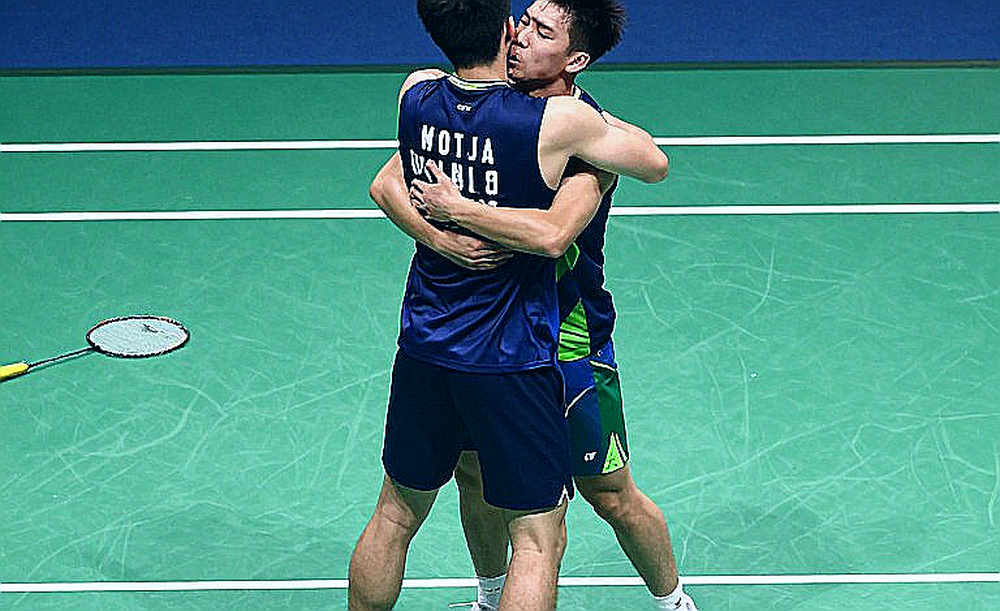
At 17-17 in the deciding game, the shuttle crossed the net exactly 36 times before Satwiksairaj Rankireddy sealed the point with a cross-court smash. In men's doubles, the average rally lasts only five to eight shots. Thirty-six is almost an anomaly. It was no accident. Both sides had read each other's patterns, and at the decisive moment, Satwik-Chirag forced their opponents into the space they controlled better: extended rallies where baseline stamina and the precision of the cut shot decide everything. I noted that moment in my book because it summarized the whole match, and the whole 2026 season of this Indian pair.
China Masters 2026, a Super 750 event with US$1,250,000 in total prize money and 11,000 ranking points for the champion, took place in Shenzhen one month after the World Championships and just before the Asian Games. That position turns it into a form-check milestone, not a destination. For Satwik-Chirag, it was also a points-defense event: they finished runners-up in 2026 with 9,350 points, so any result below that ranking meant a net point loss. Their semifinal run this year earns 7,700 points, roughly 1,650 fewer than a year ago. In men's singles, Kidambi Srikanth, a former world No. 1 in 2026, entered at No. 34, aged 33, and exited after a straight-games defeat, 16-21, 16-21, to Lee Cheuk Yiu.
Those two results sit side by side in the same feed, yet they belong to two entirely different trajectories within Indian badminton. One side is trying to climb back to the top after a season of injuries and setbacks. The other is entering the final stretch of a career, and that loss was not the accident of a single evening but the conclusion of years of accumulation.
Let me open the movement map of the men's doubles semifinal first. Satwik-Chirag began with a dominant first game, 21-13. It is a familiar script from their 2026 season: early explosion, pushing the match tempo beyond what opponents can follow, leveraging Satwik's back-court power and Chirag Shetty's net speed. But in game two, Astrup-Rasmussen raised their intensity after the mid-game interval, flipping 10-11 into 21-16. This is the most tactically significant detail.
What happened in that window? The Danes did not change their structure. They changed their rhythm at the point of contact with the serve. The Indian pair builds points on the first three shots initiated by Chirag: short serve, net interception, then opening the gap for Satwik to finish. Astrup-Rasmussen began blocking that third shot, forcing Indian attacks to stretch, and in extended rallies they defended as a unit more effectively. Game two was a lesson in how an attacking pattern can be decoded within a single interval.
I rewatched the footage of their loss to this same pair in the World Championships quarterfinal in August. The script was identical: strong start, reversal, struggle in the deciding game. The Danes have found the unknown in Satwik-Chirag's equation. This is no longer about form. It is about structure.
The third game in Shenzhen was an in-match correction. Satwik-Chirag simplified: less rotational complexity, more direct smashing from Satwik at the back, and a tighter net zone for Chirag. They allowed the Danes to lead 15-17, then won six of the last seven points. The 36-shot rally at 17-17 was the moment they forced Astrup-Rasmussen into a contest decided by baseline stamina. That was a spatial victory as much as a psychological one: they proved that when simplified, their attacking pattern can still overcome an opponent who has decoded them.
But I must state the level of my uncertainty clearly. One win does not reverse a head-to-head. Their overall record against Astrup-Rasmussen remains 4-6 in favor of the Danes. This is a step forward, not an overthrow.
The greater concern lies in the schedule. Satwik-Chirag withdrew mid-match at the Indonesia Open in June due to injury. The Badminton Association of India only stated they would "focus on recovery and rehabilitation," without specifying the nature or severity. That ambiguity makes external risk assessment nearly impossible. Only three months later, they competed back-to-back at the World Championships and the China Masters at high intensity. Either the injury was minor and fully healed, or they prioritized major events over long-term health. There is no data to distinguish the two.
For a pair that relies on explosive speed and power, any lower-body injury is a structural risk. I often ask myself: if only 70 percent of the physical capacity remains, does this schematic still function? For Satwik-Chirag in Shenzhen, the answer was yes, but only for one game. They won game one 21-13; they collapsed in game two. That stamina curve is a warning signal, not a statement of recovery.
Every lineup is a spatial equation; we just have not found the unknown yet. The Indian pair currently sits in the second tier of world men's doubles, behind Liang Weikeng-Wang Chang and Kim Won-ho-Seo Seung-jae. The gap is not insurmountable, but it demands three conditions: extended injury-free periods, tactical adaptability against pairs that have read them, and form at the decisive stages of major tournaments. The Shenzhen win partly satisfies the third. The other two remain suspended.
Now to men's singles. Srikanth entered the China Masters quarterfinal as an unseeded player, facing Lee Cheuk Yiu, a 30-year-old from Hong Kong ranked No. 25. The head-to-head was 1-3 in Lee's favor, and Lee had won the last three meetings, in 2026, 2026 and 2026. The 16-21, 16-21 scoreline reflects the actual distance between a top-25 player and a former champion in decline. No deciding game. No sign of a comeback.
I have followed Srikanth since his peak years. What stood out in this match was how he lost his scoring runs. He still had sharp attacks, enough to win isolated points, but he could not sustain pressure across a full game. That is a sign of physical decline, not technical failure. The peak of men's singles usually falls between ages 22 and 28. At 33, the gap between Srikanth and his own 2026 self cannot be closed again.
His best result in the 2026 season was a runner-up finish at the US Open, a Super 300 event where most top-20 players did not participate. That is not a signal of resurgence. He once targeted a top-25 ranking in 2026. He currently sits at No. 34. That target was not met.
The more important issue lies on the system side. Indian badminton has Lakshya Sen in the top 20 range, HS Prannoy in the top 25 range, and Srikanth at No. 34. China has more than four players inside the top 30. Japan, Denmark and Chinese Taipei all have more stable men's singles depth. The fact that Srikanth, at 33 and ranked No. 34 with no realistic path to the top 10, is still competing at Super 750 events is not a personal tragedy. It is a sign of missing successors.
I once worked in a scouting environment where the scoring system relied solely on 30-meter sprint speed and height. We completely ignored the ability to read space. That was a structural mistake, and I suspect Indian badminton faces a similar gap at the men's singles development level: they can produce good players at any given moment, but they have not built a continuous pipeline.
This is the point where I want to push back directly. The popular reading in Indian media is that "Srikanth is declining." That reading places responsibility on an individual and ignores the systemic layer. It also conveniently mirrors the reading of Satwik-Chirag: "they held their nerve in the deciding game."
Space never lies; only those who read it in a hurry do.
The "China Masters specialist" label attached to Satwik-Chirag is also a trap. Yes, they have reached the semifinals in every edition since 2026. But that label masks their inconsistency elsewhere. If they truly belonged at the level of Liang-Wei or Kim-Seo, they would have won this event at least once in seven years. They finished runners-up in 2026 and 2026. There is a psychological knot in the closing stages of this tournament that the coaching staff has not untied. I assign low confidence to this hypothesis because my sample is insufficient, but it deserves monitoring.
As for Srikanth, I do not believe in a revival scenario. But I also do not think he should be removed from the national squad. In team events like the Thomas Cup, a former world No. 1 with match experience still holds value as a mentor and in a leadership role. The issue is that Indian badminton must give young players Super 750 exposure now, not wait until Srikanth announces retirement.
For Satwik-Chirag, the window is clearer. The Asian Games take place in late 2026, where they are the defending champions. That event can define their entire cycle. If they maintain fitness until then, they have a chance to reproduce their highest level, as in the Singapore Open final in May when they defeated Kim-Seo, the reigning world champions on a 34-match winning streak. If not, everything depends on luck, and luck is not part of my equation.
Their current ranking is No. 5. If they fail to defend their China Masters points, they could drop out of the top 8, losing seeding rights at Super 1000 events and facing Liang-Wang or Kim-Seo early. That is not a distant scenario. It is the direct consequence of a points calculation.
I will monitor two indicators over the next three months. For Satwik-Chirag: the number of mid-match withdrawals and tournament density before the Asian Games. For Srikanth: how deep he goes at Super 500 events and above, and signals from the federation about succession planning. Both indicators have clear trigger thresholds, and both will tell me whether the preliminary conclusions in Shenzhen hold up.
The China Masters semifinal raises a question no scoreboard can answer: when a pair must choose between long-term health and short-term results, and when a player must choose between continuing and stepping aside, who is reading the space correctly, the athlete, the coach, or the very system that produced them?
Cầu thủ liên quan
Bài đề xuất
From 11-15 to 21-18: Srikanth and India's tactical puzzle at China Masters 20262026-09-04
India's Badminton Squad for Asian Games 2026: When the Number 20 Hides a Worry2026-09-11
Notice: Article Cannot Be Created — Source Analysis Is Empty2026-09-06
Young Chinese Talent Stops Vietnam's No.1 at Vietnam Open First Round2026-09-10
China Masters 2026: Satwik-Chirag's Spatial Equation and Srikanth's Final Crack2026-09-12
Ashmita Chaliha Questions BWF: Double Standards in Tournament Governance?2026-09-03